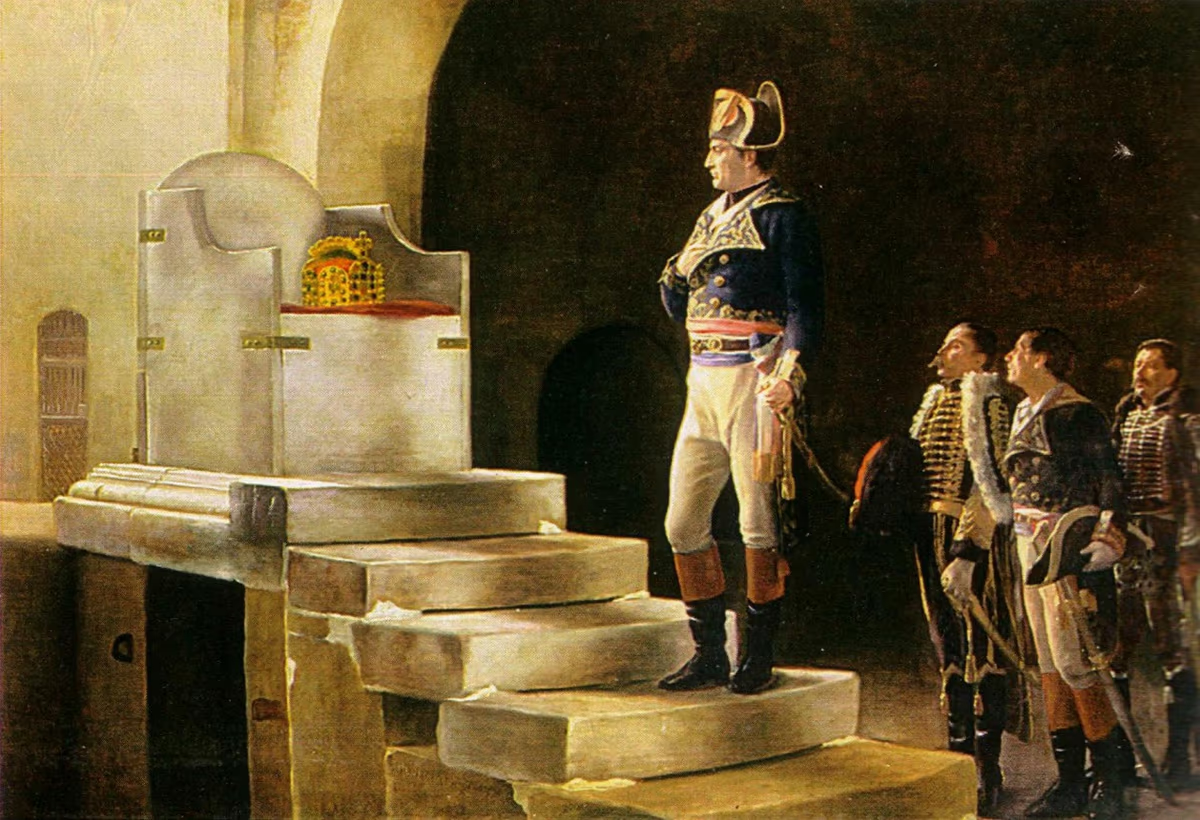
Henri-Paul Motte, Bonaparte before the throne of Charlemagne at Aachen, 1898 — exhibited at the Salon of 1898 — public domain (Wikimedia Commons)
Who Did Napoleon Admire? The Heroes Great Leaders Copied
Napoleon studied Alexander, Hannibal and Caesar; Caesar envied Alexander, who slept beside the Iliad. Ten leaders, the models they chose, and what each one did.
Did Napoleon admire Alexander the Great? Did he look up to Julius Caesar? Yes to both, and he said so in writing. But the more useful question is a different one: what did he do with them? Great leaders rarely pick a model at random. They pick one that answers a need at a precise moment — learning a trade, justifying a throne, measuring their own career against someone else’s. The choice says as much about the person choosing as about the hero chosen.
Ten cases, from Macedon to Berlin, with the same three questions each time: who was the model, how do we know, and what was it used for.
Napoleon: three generals to imitate, one emperor to invoke
The plainest statement of Napoleon’s admiration is Maxim LXXVIII of his Maxims of War, a collection compiled from his writings and published after his death: read again and again the campaigns of Alexander, Hannibal, Caesar, Gustavus Adolphus, Turenne, Eugene and Frederick, and model yourself on them — “the only means of becoming a great captain”. The list is technical. These are commanders whose operations can be studied, not saints to venerate.
Caesar received the most sustained attention. In exile on Saint Helena, Napoleon dictated a Summary of the Wars of Julius Caesar to his valet Louis Marchand, who published it in 1836. Scholars treat the Saint Helena dictations with some caution, since later editions were reworked, but the choice of subject is not in doubt: a deposed emperor spent his last years going over the campaigns of the man who had ended a republic.
Alexander supplied something else, an imaginary of the East. The Egyptian expedition of 1798 had a hard strategic purpose — threatening the British route to India — but an army that brought scholars along and marched on the Nile invited the comparison with Alexander, and Napoleon did nothing to discourage it. The comparison between the two conquerors is examined in detail in Napoleon vs Alexander the Great.
The fourth model was not a general at all. From 2 to 11 September 1804, three months before his coronation, Napoleon stayed at Aachen and on 7 September visited the presumed tomb of Charlemagne. The hero image above, painted by Henri-Paul Motte in 1898, imagines that moment before the stone throne. Charlemagne was not a model of strategy; he was a model of title. A Frankish king crowned emperor by a pope in Rome in 800 gave a precedent to a man who had none. The parallel is developed in Charlemagne vs Napoleon.
Alexander: the Iliad under the pillow
Alexander himself had a model, and it was not a historical figure. Under Aristotle’s teaching he took a passion for Homer, and Aristotle gave him an annotated copy of the Iliad. Plutarch, citing Onesicritus, writes that Alexander kept it under his pillow with his dagger; later he stored it in a precious casket taken from the possessions of Darius.
When he crossed into Asia in 334 BC, he stopped at Troy. Arrian and Plutarch both report that he honoured the tomb of Achilles, while Hephaestion honoured that of Patroclus. Arrian adds that Alexander called Achilles fortunate for having had Homer to proclaim his fame. The remark tells us what the model was for: Achilles had won glory, but he had also found someone to write it down. Alexander travelled with historians.
Caesar in front of a statue at Gades
Julius Caesar served as quaestor in Hispania in 69 BC. Suetonius tells the scene: in the temple of Hercules at Gades, today’s Cádiz, Caesar saw a statue of Alexander and sighed, because at his age Alexander had already conquered the world while he himself had done nothing memorable. He then asked to be released from his post in order to seek larger opportunities in Rome.
Plutarch places the episode later, during his governorship of Spain, and changes the setting: Caesar is reading a history of Alexander and bursts into tears. The two versions do not agree on the date or the object, and both were written more than a century after the fact. What they share is the function of the model. Alexander is not a teacher here; he is a clock. Caesar was in his early thirties, roughly the age at which Alexander died.
Hannibal’s ranking at Ephesus
In exile at the court of Antiochus III, Hannibal is said to have met Scipio Africanus at Ephesus. Livy reports the conversation: asked who was the greatest general, Hannibal named Alexander, then Pyrrhus, then himself. And if you had beaten me, asked Scipio? Then I would place myself first, Hannibal replied.
The anecdote is too neat to be taken at face value. Livy reports it on the authority of Claudius, who drew on the Greek history of Acilius, and Scipio’s presence on that embassy is not confirmed elsewhere. Most modern historians consider it a later invention. Its interest lies elsewhere: Romans found it natural that the man who nearly destroyed Rome should measure himself against Alexander. By the second century BC, the Macedonian had become the yardstick for every commander.
Bolívar at the Milan coronation
Simón Bolívar spent the years 1803 to 1807 in Europe after the death of his young wife. He stayed in Paris and in May 1805 was present in Milan when Napoleon was crowned King of Italy. It was during this same journey, according to a tradition reported decades later by his tutor Simón Rodríguez, that he swore on the Monte Sacro in Rome to free Spanish America.
The oath is attested only by that late account. The tension it summarises is better documented: Napoleon embodied for Bolívar’s generation the soldier who had turned a revolution into a state, and also the soldier who had taken a crown. Bolívar would build republics and write constitutions, then, in 1828, assume full powers in Bogotá. The model fascinated as much as it warned.
Avicenna: forty readings of Aristotle
Not every model is a ruler. Avicenna tells in his autobiography how, as a teenager in Bukhara, he read Aristotle’s Metaphysics forty times, knew it by heart and still did not understand its purpose. A bookseller then sold him, for three dirhams, a short commentary by al-Farabi, which opened the text for him.
Here the model is an author, and imitation takes the form of study. It also needs an intermediary: Aristotle reached Avicenna through a tenth-century reader writing in Arabic. Avicenna went on to build his own philosophy on that base, and through Latin translations it would in turn become a reference for European scholars.
Akbar: a dynasty commissions its ancestors
Akbar came to the throne at thirteen, in 1556, at the head of a dynasty that had just recovered India after fifteen years of exile. His grandfather Babur descended from Timur on his father’s side and, through his mother, from Genghis Khan. That double ancestry was the family’s main title to rule.
Akbar turned it into books. In 1577–1578 he commissioned the Tarikh-i Khandan-i Timuriyya, a history of Timur’s descendants in Iran and India, illustrated with 133 paintings by some fifty artists of his workshop, including Daswant and Basawan. The only surviving copy is held at the Khuda Bakhsh library in Patna and was inscribed in UNESCO’s Memory of the World register in 2011. In 1589 Babur’s Turkish memoirs were translated into Persian at his court.
The model was genealogical, not political. Akbar’s own policy — abolishing the tax on non-Muslims in 1564, opening his house of debate at Fatehpur Sikri to every faith — owed nothing to Timur. The ancestors legitimised the throne; the reign was his own.
Wu Zetian: when no model exists
Wu Zetian faced the opposite problem. To become emperor in her own name in 690, she could find no precedent in the Confucian tradition, which made no place for a woman sovereign. So she looked elsewhere.
From the past, she borrowed a name: her new dynasty was called Zhou, after the ancient house from which her clan claimed descent, the dynasty Confucius himself held up as the model of good government. From religion, she borrowed a prophecy: a passage of the Great Cloud Sutra, reinterpreted by the monk Xue Huaiyi, announced a universal female ruler, and the commentary was circulated throughout the empire. Without a model for what she was, she assembled one from available pieces.
Gandhi and King: a chain of readers
Some models are passed hand to hand. Gandhi, as a young lawyer in South Africa, read Tolstoy’s The Kingdom of God Is Within You shortly after its publication and later said it had left a lasting impression on him. The two men corresponded until Tolstoy’s death in 1910, the year Gandhi named his community near Johannesburg Tolstoy Farm.
Martin Luther King Jr. discovered Thoreau and Gandhi during his studies. In February and March 1959 he travelled to India with his wife Coretta and the historian Lawrence Reddick. On his last evening there, in a radio address, he said he was more convinced than ever that nonviolent resistance was the most potent weapon available to oppressed people. King did not copy Gandhi’s methods unchanged: boycotts, court cases and marches were adapted to the American South. But the chain is documented at each link: Tolstoy, Gandhi, King.
Hitler: Frederick the Great, and a morning at the Invalides
Adolf Hitler idolised Frederick II of Prussia. Regime propaganda had artists paint Frederick, Bismarck and Hitler together, as successive figures of a single German destiny. Hitler often compared himself to the king during the war and kept a copy of Anton Graff’s portrait of Frederick with him until the end, in the Führerbunker. In the last months he ordered Frederick’s coffin hidden in a salt mine.
Napoleon also had a place in this use of the past. On 23 June 1940, the day after the armistice, Hitler made a three-hour tour of an empty Paris with the architect Albert Speer and the sculptors Arno Breker and Hermann Giesler; the stop at Napoleon’s tomb in the Invalides is the best-known moment. On 15 December 1940, on his order, the remains of Napoleon II, the Duke of Reichstadt, were moved from Vienna to the Invalides. The gesture was aimed at French opinion in the first months of the occupation. Here the model serves as propaganda: borrowing someone else’s prestige to dress up a conquest.
What the choice of model reveals
Set side by side, the ten cases sort into three uses.
The model as a technique: Napoleon’s maxim, Avicenna’s forty readings, King’s journey to India. Something can be learned from him, and the learning is checked against practice.
The model as legitimacy: Charlemagne for Napoleon, Timur for Akbar, the Zhou for Wu Zetian, Frederick for Hitler. He supplies what the ruler lacks — a title, an ancestry, a precedent, a continuity.
The model as a yardstick: Caesar before the statue, Hannibal’s ranking, perhaps Alexander before Achilles’ tomb. He sets the measure of a career.
The same figure can serve all three. Alexander is a technique for Napoleon, a yardstick for Caesar and Hannibal, an image for the Egyptian campaign. That is why the question “who did Napoleon admire?” never has a single answer: it depends on what he needed that day.
Read Next

Greatest Conquerors in History and How They Won
Alexander, Genghis Khan, Caesar, Napoleon. The tactics that built the largest empires in history, and the mistake that brought each of them down.
20min read
Historical Figures Who Were Alive at the Same Time
Cleopatra was born closer to the Moon landing than to the Great Pyramid. Darwin and Lincoln share a birthday. Ten overlaps that break your sense of historical time.
11min read

Caesar vs Napoleon: Who Was the Better Commander?
Caesar conquered Gaul in eight years; Napoleon took Europe in ten. Compare their tactics, logistics and battlefield records, and how each one finally lost.
17min read

Charlemagne vs Napoleon: Two Attempts to Unite Europe
A thousand years apart, both crowned emperor, both trying to rebuild Rome. How each built his empire, and why neither one lasted.
16min read