Avicenna (c. 980 – 1037)
Quick Summary
Avicenna (c. 980 – 1037) was a physician and major figure in history. Born in Afshana, near Bukhara (present-day Uzbekistan), Avicenna left a lasting impact through Wrote the Canon of Medicine, a five-book summa taught in European medical faculties until the seventeenth century.
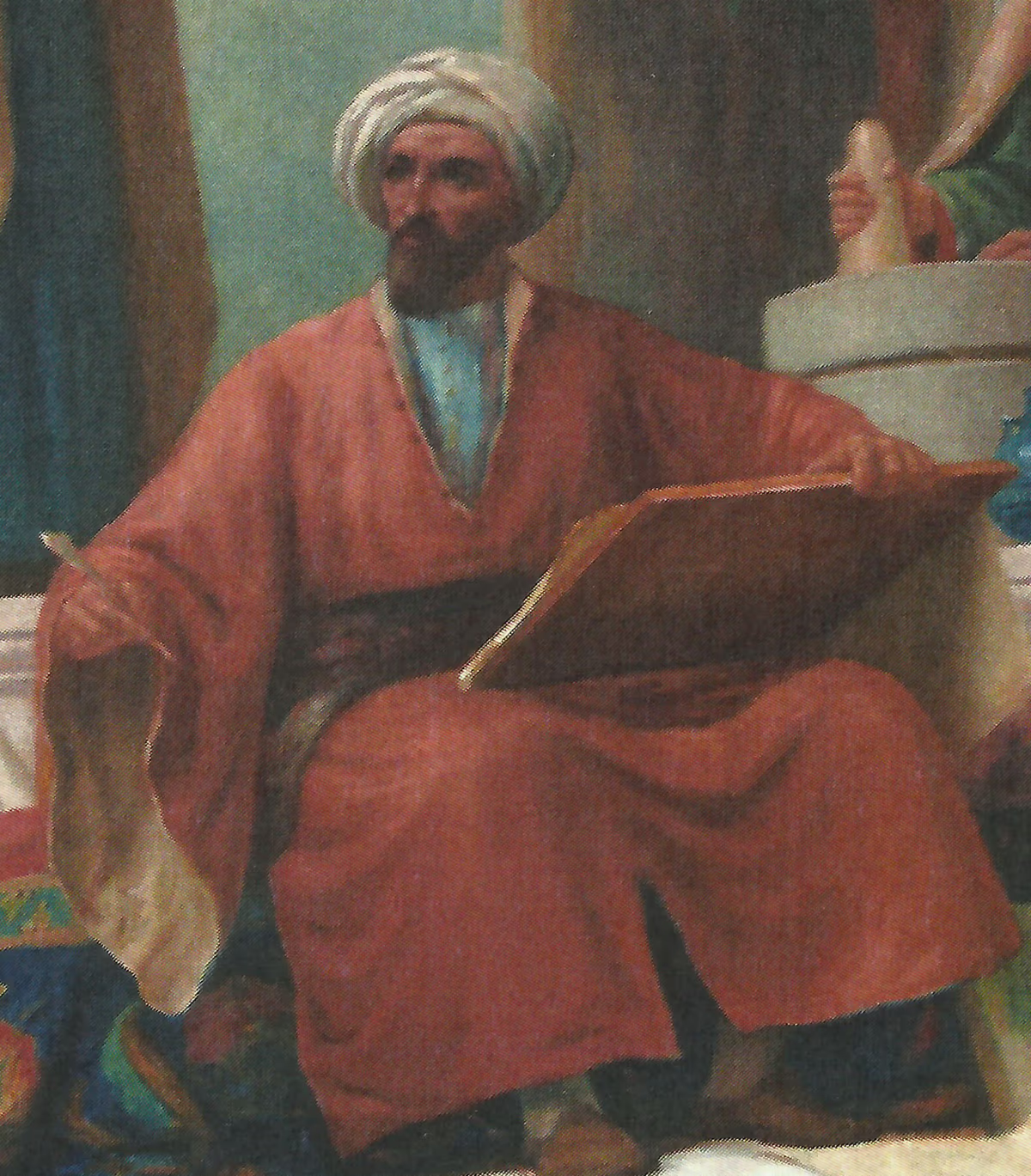
Veloso Salgado, « La médecine arabe » (Avicenne), vers 1906 — NOVA Medical School, Faculdade de Ciências Médicas, Lisbonne — domaine public (Wikimedia Commons)
Birth
980 Afshana, near Bukhara (present-day Uzbekistan)
Death
1037 Hamadan (present-day Iran)
Nationality
Persian
Occupations
Complete Biography
A Childhood In Bukhara
Abu Ali al-Husayn ibn Abd Allah ibn Sina was born around 980 in Afshana, a village near Bukhara, capital of the Samanid emirate. His father, who came from Balkh, administered a neighbouring district for the Samanids; his mother, Sitara, was from Afshana. The family soon moved into Bukhara. Nearly everything known about these years comes from an autobiography the scholar later dictated to his disciple Juzjani: the story of a prodigy, built to show a mind that teaches itself, and best read as such. By its account, he knew the Qur'an and much of Arabic literature by the age of ten. He learned Indian arithmetic from a greengrocer, law from an ascetic, and logic from a tutor, al-Natili, whom he soon outpaced to the point of explaining problems to him rather than receiving them. Ismaili preachers visited his father's house; the boy listened to their debates on the soul and the intellect without adopting their doctrine.
Medicine And The Samanid Library
At about sixteen he took up medicine, which he found, he says, "not one of the difficult sciences", and began treating patients. Metaphysics resisted him longer: he read Aristotle's Metaphysics forty times, knew it by heart and still could not grasp its purpose, until a bookseller sold him, for three dirhams, a short commentary by al-Farabi that opened the text to him. At around seventeen he was summoned to the bedside of the emir Nuh ibn Mansur, whom the court physicians had failed to cure. His reward was access to the Samanid library, a series of rooms arranged by subject where he found, he writes, books whose very titles most people had never heard. By eighteen, the autobiography claims, he had mastered the sciences of his day. These years also produced his correspondence with al-Biruni, a scholar of his own age, who sent him pointed objections to Aristotle's physics: the exchange of questions and answers survives.
Wandering Between Courts
Bukhara's security did not last. In 999 the Qarakhanids took the city and the Samanid emirate collapsed; shortly afterwards, around 1002, Ibn Sina's father died. The young man left for Gurganj, capital of Khwarazm, where the Ma'munid emirs kept a learned court and paid him a stipend. Around 1012 he left Khwarazm; an account written a century later by Nizami Arudi attributes the departure to a summons from Mahmud of Ghazni that he wished to avoid, but the autobiography says nothing of it. He drifted from town to town in Khorasan, then made for Gorgan, hoping for the patronage of the emir Qabus, a noted man of letters, who was deposed and died before he arrived. It was in Gorgan that Abu Ubayd al-Juzjani joined him and stayed for twenty-five years: his pupil, his secretary and, after his death, his biographer. A local patron gave him a house; there he began the Canon of Medicine.
Hamadan Physician And Vizier
After a stay in Rayy, where he treated the young Buyid emir Majd al-Dawla for melancholia, and a stop in Qazvin, Ibn Sina settled around 1015 in Hamadan, at the court of another Buyid, Shams al-Dawla. He treated the emir for colic, joined his household and became his vizier. The political venture went badly: the troops mutinied against him, looted his house and demanded his death. The emir refused to hand him over but sent him away; Ibn Sina hid for forty days at a friend's house, then was recalled when the emir's colic returned, and restored to office. These were his most productive years. Juzjani describes the routine: the day spent on state business, the night on teaching, the students reading in turn from the Book of Healing and the Canon, before the evening ended with music and wine. It was at Juzjani's request that he then undertook the Book of Healing, a vast commentary on the whole of Aristotelian philosophy, which he sometimes wrote at a rate of fifty leaves a day.
The Fortress Of Fardajan
Shams al-Dawla died around 1021. Ibn Sina declined to serve his son and successor, and opened a secret correspondence with Ala al-Dawla, the Kakuyid emir of Isfahan. The letter was discovered; he was arrested and held for four months in the fortress of Fardajan, near Hamadan. There, according to Juzjani, he wrote several works, among them a treatise on colic, a philosophical digest called The Guidance, and the allegorical tale Hayy ibn Yaqzan, in which an old man embodies the intellect that guides the soul. Released amid the military upheavals of 1023, he stayed on in Hamadan for a while, then fled around 1024, disguised as a Sufi, with Juzjani, his brother and two servants. They reached Isfahan, where Ala al-Dawla received him with the honours due to a famous scholar. The episode sums up the condition of his whole life: an author whose work depended on a prince's survival, and whose freedom turned on the outcome of rivalries between dynasties.
Isfahan And The Last Years
In Isfahan, Ibn Sina spent his last thirteen years in a stability he had never known. Every Friday evening the emir gathered scholars around him, and Ibn Sina dominated the debates. He finished the Book of Healing, drew an abridgement from it, The Salvation, and wrote for his patron, in Persian, the Book of Knowledge for Ala al-Dawla, one of the first expositions of philosophy in that language. At the emir's request he also undertook astronomical observations to correct the tables in use, and designed an instrument for the purpose. Around 1030 the Ghaznavid troops of Sultan Mas'ud took Isfahan; his baggage was plundered and several manuscripts were lost, including a multi-volume work, The Fair Judgement, in which he arbitrated between the commentators on Aristotle. His last writings, among them Pointers and Reminders, take a tighter, almost allusive form. In 1037 he accompanied the emir on campaign towards Hamadan, suffered a fresh attack of colic that he treated himself too harshly, and died in June in Hamadan, where he is buried.
The Canon Of Medicine
The Canon of Medicine, completed in Hamadan, is a summa in five books: the general principles of medicine, simple remedies, the diseases of each organ from head to foot, conditions that affect the whole body such as fevers, and compound remedies. Ibn Sina ordered the legacy of Galen and Hippocrates, received through Arabic translations, and added what Arabic-writing physicians, al-Razi among them, had contributed. He did more than compile: the second book sets out the conditions under which a remedy must be tested before an effect can be ascribed to it, trying it on a simple disease, at a measured dose, on several cases, and watching whether the result is consistent. Translated into Latin in Toledo in the twelfth century by Gerard of Cremona, the Canon became the standard textbook of European medical faculties and was still taught there in the seventeenth century. It was against this authority that Paracelsus, in Basel in 1527, symbolically threw the works of Galen and Avicenna into the fire. Dante, for his part, had placed Avicenna in Limbo, between Hippocrates and Galen.
The Book Of Healing And The Flying Man
The Book of Healing (al-Shifa), whose title refers to healing the soul of ignorance, covers logic, the natural sciences, mathematics including music, and metaphysics. In it Ibn Sina distinguishes a thing's essence from its existence: what a being is does not tell us that it is. From this follows his proof of the Necessary Existent, a being whose essence entails its existence and on which every merely possible being depends. From it, too, comes the thought experiment of the "flying man": a man created all at once, fully grown, suspended in the air, eyes covered, limbs held apart so they do not touch; deprived of every sensation, he would still affirm that he exists, which shows, for Ibn Sina, that self-awareness does not pass through the body. Partly translated into Latin in Toledo in the twelfth century, the book fed scholasticism from Albert the Great to Thomas Aquinas. In the Islamic world, al-Ghazali condemned three of its theses around 1095: the eternity of the world, God's knowledge of universals only, and the denial of bodily resurrection. Averroes answered him, and the Avicennian tradition continued, from Fakhr al-Din al-Razi to Nasir al-Din al-Tusi.
Achievements and Legacy
Major Achievements
- Wrote the Canon of Medicine, a five-book summa taught in European medical faculties until the seventeenth century
- Wrote the Book of Healing, a philosophical encyclopedia covering logic, physics, mathematics and metaphysics
- Set out conditions for testing a remedy: a simple disease, a measured dose, repeated cases, a consistent effect
- Distinguished essence from existence and argued for a Necessary Existent, ideas taken up by Latin scholasticism
- Devised the "flying man" thought experiment on self-awareness independent of the senses
- Wrote the Book of Knowledge for Ala al-Dawla, one of the first works of philosophy written in Persian
- Served as vizier to the Buyid emir Shams al-Dawla in Hamadan
Historical Legacy
Few authors have weighed so long on two traditions at once. In the Latin West, the Canon gave medical teaching its structure for nearly five centuries, and it was by opposing it that Renaissance medicine began to free itself from the ancients; Avicenna's metaphysics, meanwhile, supplied scholasticism with the distinction between essence and existence. In the Islamic world his work was not a stage but a starting point: after al-Ghazali's attacks, it was his texts, rather than Aristotle's, that commentators worked on, well into the modern era. Several countries now claim him, Iran, Uzbekistan and Tajikistan among them, honouring him on banknotes, stamps and monuments; his mausoleum in Hamadan was rebuilt in the mid-twentieth century. Recent scholarship, notably that of Dimitri Gutas, suggests reading his autobiography as a statement of method rather than a testimony, and measuring his originality through patient comparison with his Greek and Arabic sources.
Detailed Timeline
Major Events
Birth
Around 980, in Afshana, near Bukhara, in the Samanid emirate.
Physician to the emir Nuh ibn Mansur
At about seventeen he treats the Samanid emir and gains access to the royal library in Bukhara.
Fall of Bukhara
The Qarakhanids take the city; the Samanid emirate collapses.
Departure for Khwarazm
Around 1002, after his father's death, he moves to Gurganj and the court of the Ma'munid emirs.
Gorgan and the meeting with Juzjani
Around 1012; Juzjani becomes his pupil and secretary. He begins the Canon of Medicine.
Physician, then vizier, in Hamadan
Around 1015, in the service of the Buyid emir Shams al-Dawla; he begins the Book of Healing.
Captivity at Fardajan
Four months in a fortress for corresponding with the emir of Isfahan; he writes Hayy ibn Yaqzan there.
Flight to Isfahan
Around 1024, disguised as a Sufi, he joins the court of Ala al-Dawla.
Sack of Isfahan
Around 1030 the Ghaznavids take the city; part of his manuscripts is lost.
Death in Hamadan
In June, during one of the emir's campaigns, carried off by colic.
The Canon in Latin
Gerard of Cremona, who translated it in Toledo, dies this year; the Canon enters European teaching.
Geographic Timeline
Famous Quotes
"Medicine is not one of the difficult sciences, and so I excelled in it in a very short time." — autobiography dictated to Juzjani.
"I read the Metaphysics forty times, until I had it by heart, without understanding its purpose." — autobiography dictated to Juzjani, before the episode of al-Farabi's commentary.
External Links
Frequently Asked Questions
Who was Avicenna?
A Persian physician and philosopher, Ibn Sina by name (c. 980 – 1037), born near Bukhara and died in Hamadan. He wrote the Canon of Medicine, the standard textbook of European medical faculties until the seventeenth century, and the Book of Healing, a summa of Aristotelian philosophy that left its mark on both Islamic thought and Latin scholasticism.
Why is Ibn Sina called Avicenna?
It is the form his name took in the Latin translations of the twelfth century, made notably in Toledo, probably by way of Hebrew. The same process turned Ibn Rushd into Averroes. In the Persian-speaking world he is commonly called Bu Ali Sina.
Was Avicenna Arab or Persian?
Persian: he was born into an Iranian milieu in the Samanid emirate and spent his life at courts in what is now Iran. He wrote mostly in Arabic, the learned language of his time, and also composed works in Persian. His birthplace lies in present-day Uzbekistan, which is why several countries claim him.
What is the Canon of Medicine?
A five-book summa that organizes Greek medicine, Galen's above all, together with the contributions of Arabic-writing physicians: general principles, simple remedies, diseases organ by organ, general conditions such as fevers, and compound remedies. Translated into Latin by Gerard of Cremona in the twelfth century, it was printed and commented on in Europe until the seventeenth century.
What is Avicenna's "flying man"?
A thought experiment from the Book of Healing: a man created fully grown, suspended in the air, eyes covered and limbs apart, deprived of every sensation, would still know that he exists. Ibn Sina concludes that the soul is aware of itself independently of the body. The argument has often been compared, much later, to Descartes' "I think".
Sources and Bibliography
Primary Sources
- Ibn Sina, al-Qanun fi al-tibb (Canon de la médecine)
- Ibn Sina, Kitab al-Shifa (Livre de la guérison)
- Ibn Sina et Abu Ubayd al-Juzjani, Sira (autobiographie et biographie)
Secondary Sources
- William E. Gohlman, The Life of Ibn Sina: A Critical Edition and Annotated Translation
- Dimitri Gutas, Avicenna and the Aristotelian Tradition
- Jon McGinnis, Avicenna
- Dimitri Gutas, « Ibn Sina [Avicenna] », Stanford Encyclopedia of Philosophy
External References
See Also
Related Figures
Hildegard of Bingen
Benedictine abbess, composer, and visionary of the twelfth century

Hypatia of Alexandria
Neoplatonist philosopher, mathematician, and astronomer of late antiquity
Ibn Khaldun
Historian, jurist, and pioneer of sociology in the 14th century
Paracelsus
Swiss physician, alchemist, and natural philosopher of the 16th century
Specialized Sites
Batailles de France
Discover battles related to this figure
Dynasties Legacy
In preparationFuture site on royal and noble lineages (not available yet)
Timeline France
In preparationFuture chronological timeline site (not available yet)