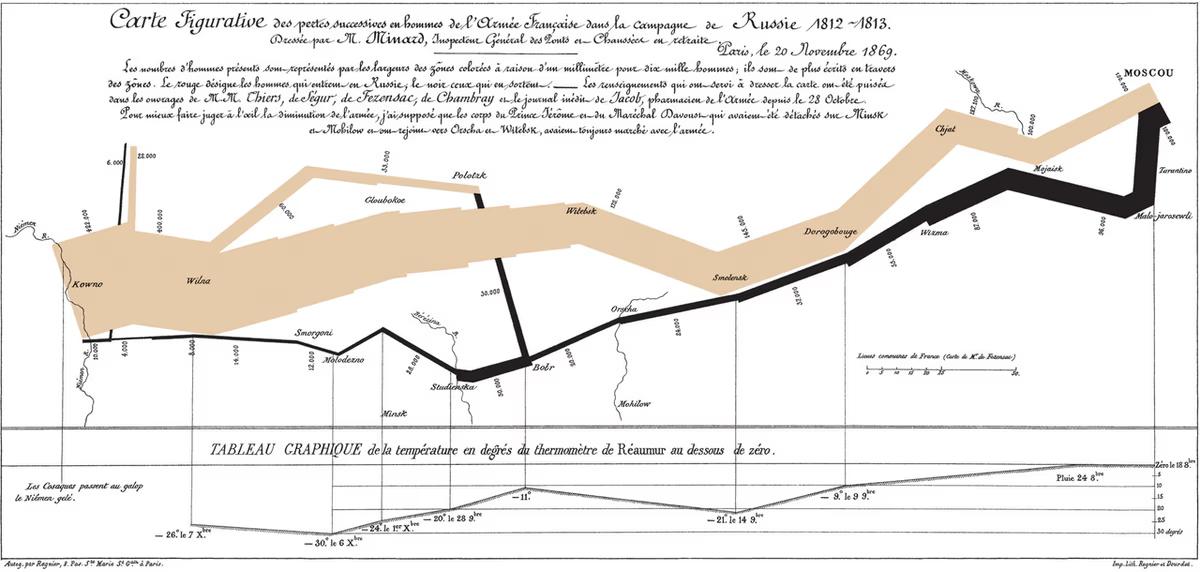
Charles Joseph Minard, Figurative map of the successive losses in men of the French army in the Russian campaign 1812–1813, lithograph, 1869 — public domain (Wikimedia Commons)
Napoleon and Hitler in Russia: Was It Really the Winter?
Napoleon and Hitler both invaded Russia in late June, and both blamed the cold. Dates and troop counts show their armies were failing before winter arrived.
Two invaders, one explanation. Napoleon crossed the Niemen on 24 June 1812; Hitler sent his armies across the Soviet border on 22 June 1941. Both campaigns ended in disaster, and both are routinely summed up in two words: General Winter. The phrase is convenient, memorable and largely wrong. Winter was real, and it killed. But in both cases the armies that met the cold had already been worn down by distance, disease, supply failures and the decisions of the men who led them.
The comparison is worth making precisely because the two campaigns are so different in scale and purpose. If the same myth fits both, it is because it serves the same need: to explain a defeat without blaming the people who planned it.
Who blamed the weather first
The story was launched by the losers themselves. On 3 December 1812, at Molodechno, Napoleon dictated the 29th Bulletin of the Grande Armée, the first official admission in France that the campaign had gone wrong. It opens with a sentence that sets the tone for two centuries: “Until 6 November the weather was perfect.” Everything that followed — the collapse, the lost horses, the abandoned guns — is attributed to the sudden cold. The bulletin, published in Le Moniteur on 17 December, ends by reassuring readers that “the health of His Majesty has never been better.” Two days after dictating it, Napoleon left the army at Smorgon and hurried back to Paris.
In December 1941, as the German advance stalled before Moscow, Hitler’s Führer Directive No. 39 explained the suspension of offensive operations by the early onset of winter and the severe cold. It was the same move: an account written by the man responsible, placing the cause outside his control. The site has already looked at what happens when history is written by its own actors; the winter story is one of its most durable products, and it belongs alongside the other history myths everyone still believes.
1812: an army that shrank in summer
Napoleon’s force numbered more than 450,000 men in the first line, with over 150,000 horses and nearly 1,400 guns. It entered Russia in the campaign of 1812 under an intense June heat, followed at the end of the month by storms that turned the roads into mud.
The losses began immediately, and they were not caused by frost. The central body of the army lost about a third of its strength in the first eight weeks, before any major battle. Typhus, dysentery and diphtheria spread through the columns; men starved because wagons could not keep pace with forced marches; deserters left by the thousand; horses died in such numbers that cavalry and artillery were weakened long before autumn. Garrisons had to be left behind to hold supply points along a line that grew longer every day.
Charles Joseph Minard’s famous chart of 1869, reproduced at the top of this page, makes the point at a glance. His beige band, drawn from the accounts of Ségur, Fezensac, Chambray and others, starts at 422,000 men at the Niemen and has thinned to 100,000 by the time it reaches Moscow. His temperature curve, at the bottom, only begins on the way back. Most of the army had vanished before the first snowflake.
The one great battle Napoleon wanted came late and settled nothing. At Borodino, on 7 September 1812, two armies of roughly 120,000 to 130,000 men each fought for a day. The Russians lost around 45,000 men, the French about 28,000 killed or wounded, including 49 generals. The Russian army withdrew in order and survived.
Moscow: a capital that delivered nothing
Napoleon entered Moscow on 14 September with an army of about 100,000. The city was nearly empty, and that same day it began to burn. The fire of Moscow, set by the Russians under the military governor Fyodor Rostopchin, destroyed most of the city over the following days.
Napoleon stayed about five weeks, waiting for a peace offer from Tsar Alexander I that never came. This is the strategic heart of the failure. He had planned a short campaign ending in a decisive battle and a negotiated peace, the pattern of Austerlitz and Friedland. Russia refused to play that game, and the occupation of the old capital turned out to be worth nothing. When the army finally left on 19 October, it was still autumn.
When the cold actually came
The first serious snowstorm hit on 7 November, more than four months after the crossing of the Niemen. From then on the cold did its work: men without winter clothing froze at night, the last horses died, and stragglers were picked off by Cossacks. At the crossing of the Berezina, from 26 to 29 November, Napoleon had around 49,000 soldiers still under arms, followed by perhaps 40,000 stragglers; when the bridges were burned on the morning of the 29th, thousands were left on the wrong bank.
By mid-December, fewer than 30,000 soldiers recrossed the Niemen in good enough order to be counted. The retreat from Russia is where the iconic images come from, which is why it dominates memory. Modern historians largely reject “General Winter” as the main cause: the cold finished off an army whose disintegration was already far advanced, and which had been weakened by choices made in Paris and Vilnius, not in the sky.
1941: the same calendar, a different war
Hitler’s invasion began on 22 June 1941 with more than 3.8 million Axis troops on a front of about 2,900 kilometres. It was not an attempt to force a peace treaty but a war of conquest and annihilation, and it had a different shape: a mechanised army, railways, radio, aircraft. Yet the questions of distance and supply came back almost unchanged.
In August, against the advice of several of his generals, Hitler diverted the armoured forces of Army Group Centre north and south, temporarily halting the drive on Moscow. The southern thrust produced the encirclement of Kiev, closed on 16 September: an immense tactical victory, with Soviet losses of more than 450,000 men, but also weeks lost on the road to the capital. Operation Typhoon, the offensive on Moscow, only began on 30 September.
Then came the autumn rains. Unpaved Soviet roads turned into mud, and motor vehicles sank as Napoleon’s wagons had. On 31 October the German high command halted the offensive to reorganise. When it resumed on frozen ground in mid-November, the temperature in Moscow had fallen to −12 °C, and the supply system was already failing: ammunition and fuel had been given priority over food and winter clothing. The Wehrmacht had planned for a campaign that would be over before winter, so it had not prepared for one.
On 5 December the Red Army counter-attacked with about 1.1 million men, including divisions brought from the Far East once Soviet intelligence was confident that Japan would not attack. When that counter-offensive halted in early January 1942, the Wehrmacht had lost the battle for Moscow, and the invasion had cost the German army more than 830,000 men. Hitler’s answer was to blame his generals: on 19 December 1941 he removed the commander-in-chief of the army, Walther von Brauchitsch, and took personal command of the army himself.
The defeats that came in summer
The winter explanation fits Napoleon’s campaign badly; it fits Hitler’s war even less, because that war did not end in 1941. It lasted almost four more years, through all seasons.
Winter certainly played its part at Stalingrad, where the Soviet counter-offensive launched on 19 November 1942 encircled the German Sixth Army; the last German units in the city surrendered on 2 February 1943, and about 235,000 men were taken prisoner. But the greatest single disaster of the German army in the East came in summer. Operation Bagration, launched on 22 June 1944 — three years to the day after the invasion — destroyed 28 divisions of Army Group Centre and shattered the front; German losses are estimated at around 400,000 men in two months.
Nor was the Soviet Union fighting alone. Within weeks of the invasion, Winston Churchill’s government signed the Anglo-Soviet Agreement of 12 July 1941, a pledge of mutual assistance and no separate peace. In October 1941, Franklin D. Roosevelt’s administration extended Lend-Lease aid to the USSR. A war of production and manpower on that scale was not decided by one cold season.
What the two campaigns really share
Set side by side, the two invasions show common features that have nothing to do with the weather:
- A plan built on a short war. Napoleon expected a decisive battle and a peace offer; Hitler’s planners expected the Soviet state to collapse within months. Neither prepared seriously for the alternative.
- Supply over impossible distances. Wagons in 1812, trucks and railways in 1941: in both cases, the army outran what could be brought to it.
- A capital taken for a goal. Moscow was reached in 1812 and approached in 1941; in neither case would its capture have ended the war.
- An underestimated opponent. Russia in 1812 traded space for time and kept its army intact; the Soviet Union in 1941 raised new armies faster than they could be destroyed.
The differences matter as much. Napoleon lost his army in six months, and Russian troops entered Paris with the allies in March 1814; Hitler lost the initiative in 1941 but fought on until his defeat in 1945. One was a campaign of political pressure on a rival emperor, the other a war of extermination. Comparing them is useful only if we do not erase that difference.
Why the winter story lasts
“General Winter” has three advantages. It is simple. It produces strong images, from the Berezina to frozen German soldiers outside Moscow. And it absolves the commanders: if nature won, nobody lost. The two men who most needed that story wrote its first versions themselves.
A more accurate summary is less quotable. Winter was the last blow, not the first cause. Napoleon’s army was already crumbling in July; Hitler’s offensive was already stalled in the mud of October. For more on how Napoleon measured himself against earlier conquerors, see Napoleon vs Alexander the Great, the heroes Napoleon admired and our survey of great conquerors and how they won. What outlasted the defeat is discussed in Napoleon’s legacy in Europe.
Read Next

Julius Caesar vs Napoleon: Who Was the Greater General?
Napoleon admired Caesar and called himself “of Caesar’s race.” Compare Alesia and Austerlitz, their tactics, defeats and what each empire left behind.
17min read

Charlemagne vs Napoleon: Two Attempts to Unite Europe
A thousand years apart, both crowned emperor, both trying to rebuild Rome. How each built his empire, and why neither one lasted.
16min read

Cleopatra vs Catherine the Great: Who Held More Power?
Two queens, 1,800 years apart, ruling empires men expected to inherit. How each seized power, how she held it, and what ended her reign.
16min read
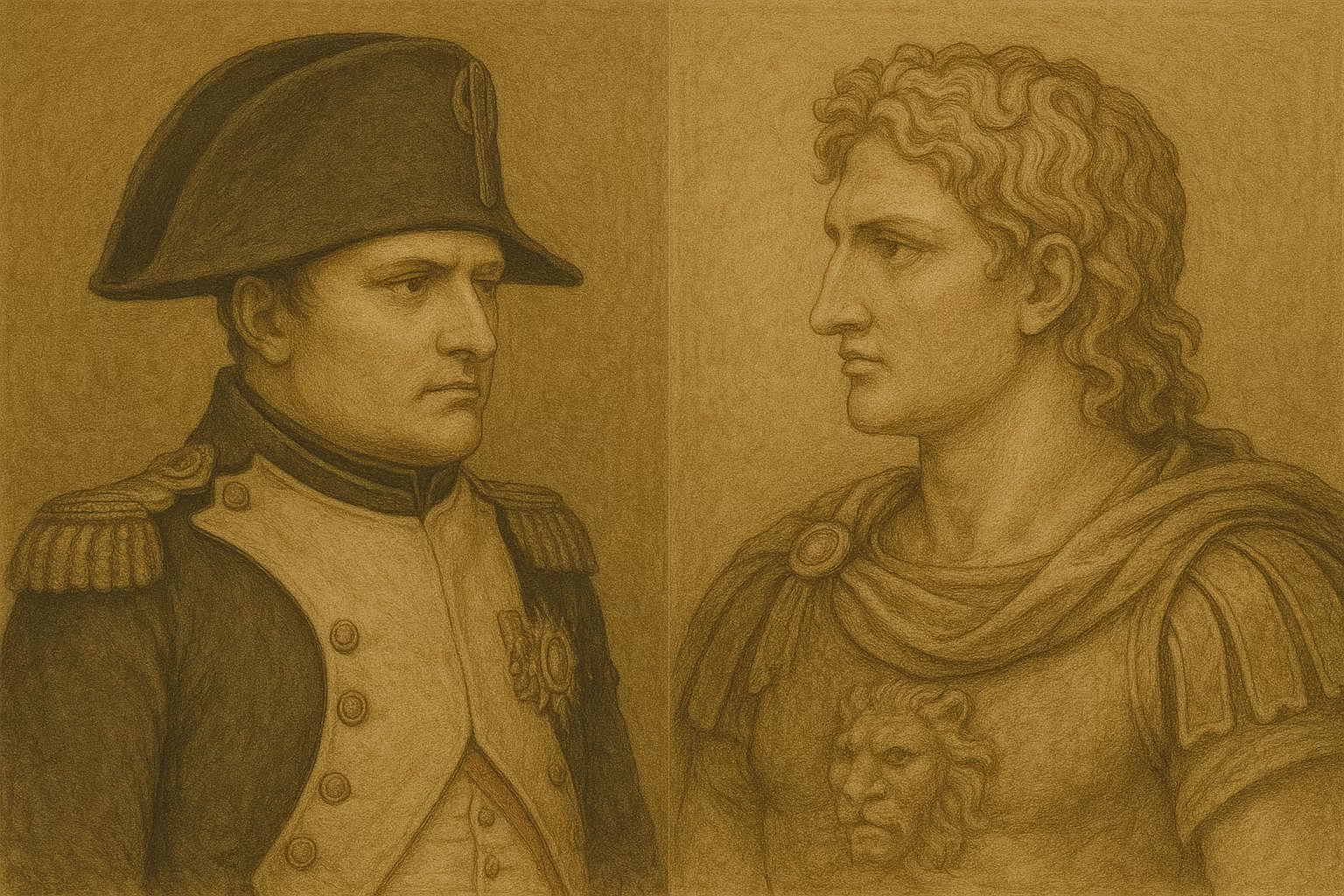
Napoleon vs Alexander the Great: Who Was Greater?
Alexander never lost a battle; Napoleon won more of them. Compare their campaigns, their empires, and how each one ambition finally outran him.
12min read