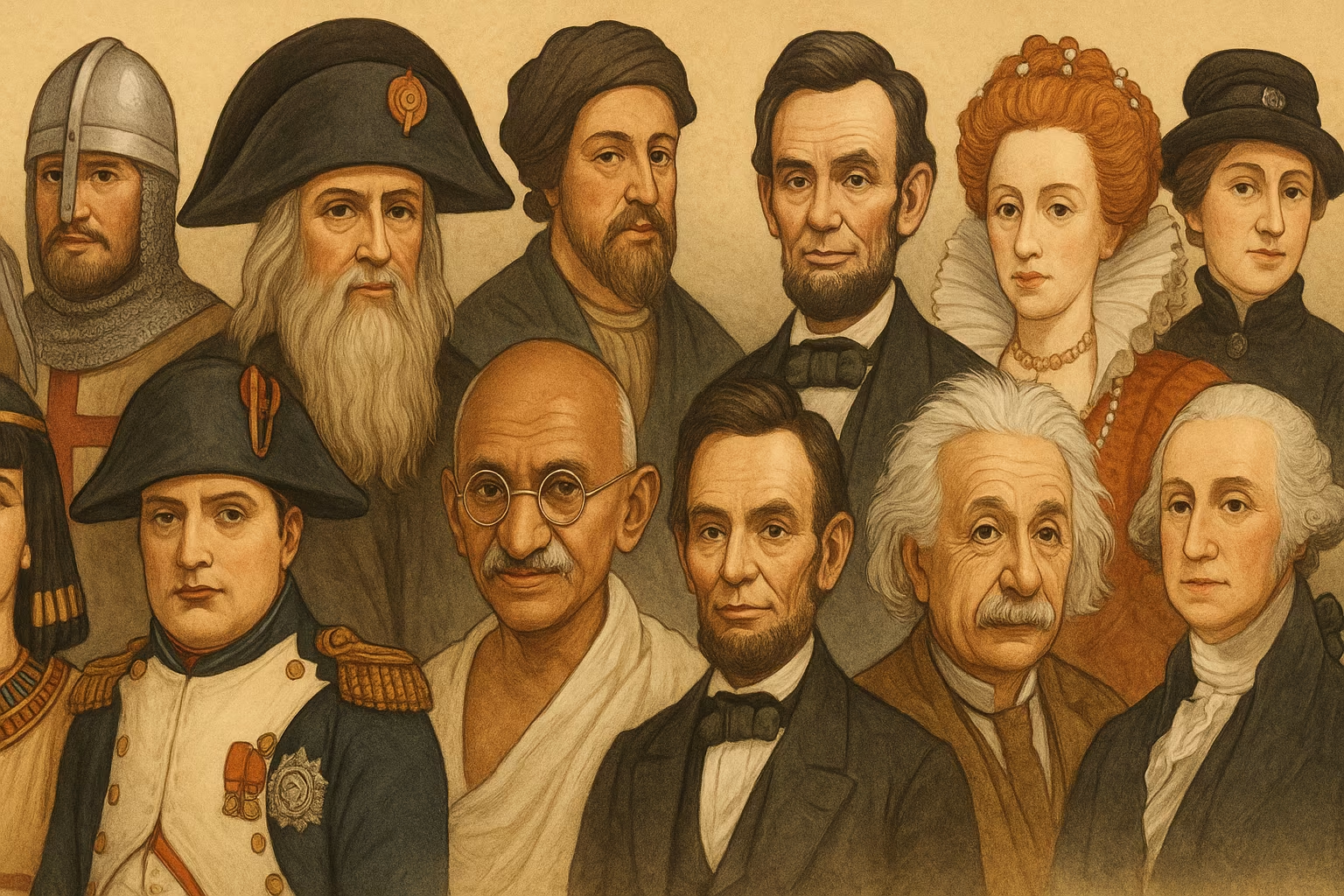
Who Held the Pen: History Written by Its Own Actors
Augustine told his conversion eleven years later, Napoleon dictated his under guard. Eight lives we know largely through a text their subject controlled.
For a great many famous lives, the main source is neither an administrative register nor an outside witness. It is a text the subject wrote, dictated or approved. Rousseau left his Confessions; Ibn Khaldun left an Autobiography documenting his own political missions. The habit spread so widely that the absence of such a text is now more conspicuous than its presence.
These accounts are not forgeries. They are written from a specific position: a date, a situation, an opponent. A man held captive, a woman the official archive turned away, a loser of a party struggle do not say the same things in the same words — and above all, none of them writes at the moment the events happen.
Three questions are enough to place a text like this. When was it written, relative to what it describes? What situation was the author in? And which rival version was it written against? Eight cases, from 397 to 1994.
Augustine — the account comes eleven years after the scene
Augustine was born in 354 at Thagaste in Numidia, into a Romano-Berber family. He left to study rhetoric in Carthage in 371, spent close to nine years among the elite “hearers” of Manichaeism, experienced the tolle lege episode in Milan in 386 followed by the retreat at Cassiciacum, and was baptised by Ambrose at the Easter vigil of 387.
The Confessions were written between 397 and 401 — at least eleven years after the conversion they narrate, and two years after their author had become bishop of Hippo in 395 and opened his major doctrinal controversies.
That does not make the account untruthful; it makes it directed. The Manichaean years appear because they serve the argument of a sitting bishop, and the trajectory takes the shape a life takes only once its ending is known. The meditation on memory and time that closes the book is not decoration: it is the author himself explaining that remembering is an operation, not a recording.
Napoleon — dictating, for want of any other move
After Waterloo, Napoleon was deported by the British to Saint Helena, in the middle of the South Atlantic. Installed at Longwood in harsh conditions and under constant watch by his jailers, he had no remaining instrument of action but one. He dictated.
The Mémorial de Sainte-Hélène, written down by Las Cases, is the product of those years. Napoleon died there on 5 May 1821, aged 51, probably of stomach cancer. The text went on working: in 1840 the retour des cendres brought his remains back in state to Paris, to the Invalides, where they still lie.
Nineteen years separate the death from that national transfer. Nothing military happened in between — only a version, written by the loser, which had been given time to become the standard one. The captivity meant to close the matter supplied the one thing it lacked: hours in which to write.
Mary Seacole — writing her way into an archive that refused her
Mary Seacole treated cholera victims in the Caribbean and Central America, then offered her services in Crimea. Official bodies turned her down. She paid for her own passage, opened the British Hotel, and combined nursing, logistics and supply for British soldiers.
In 1857 she published Wonderful Adventures of Mrs Seacole in Many Lands, one of the first autobiographies by a Black woman in the Victorian era. The case is the exact inverse of the previous one: Napoleon wrote to correct an archive that discussed him at length, while Seacole wrote because the institutional archive had excluded her and no other document recorded her work at all.
That leaves an awkward methodological consequence. Most of what we know about her comes from the one witness with an interest in her existing. This is not a reason to discount the book. It is a reason to measure what a system produces when it leaves the subject to keep her own records.
Trotsky — a body of work built against an erasure
Trotsky coordinated the October 1917 insurrection at the head of the Military Revolutionary Committee, signed the Brest-Litovsk peace in 1918, and organised and commanded the Red Army from 1919. Then the machinery reversed: expelled from the Communist Party in 1927 for opposing Stalin, deported to Alma-Ata in 1928, expelled from the Soviet Union the following year.
It was on the Turkish island of Büyükada, near Istanbul, that he wrote his memoirs, My Life, and a monumental biography of Lenin, before his History of the Russian Revolution. Expelled from Turkey in 1933, he passed through France — Royan, then Barbizon under house arrest — before reaching Mexico, from where he launched the Fourth International in 1938. The NKVD had him assassinated at Coyoacán on 21 August 1940.
What was at stake in those books was not posterity in any vague sense. They were written while a state apparatus was methodically removing his name from the official accounts of the revolution he had helped run. Here the autobiography is a legal filing, produced against a rival version that had a government behind it.
Churchill — the winner holds the pen too
Churchill was famous before he was elected: his escape from a Boer prison camp in 1899 brought him a celebrity he put straight to use. An MP from 1900, he ran a political and a journalistic career at once. In the 1930s, out of office, he wrote copiously — a monumental biography of his ancestor the Duke of Marlborough, works of military history — while issuing repeated warnings about the Nazi threat.
Prime Minister in 1940, he led the war through to victory in 1945 and lost the election that same year. Back in power in 1951, he received the Nobel Prize in Literature in 1953 for his historical work as a whole, and retired in 1955.
Read the sequence in order: the man who ran the event was honoured, eight years later, for the way he narrated it. His listed occupations set “statesman” and “historian” side by side. The combination is rare and it has consequences — a good part of what the public takes to be the history of that war passes through the pen of one of its principal actors.
Rosa Parks — thirty-seven years to correct one sentence
On 1 December 1955, Rosa Parks refused to give up her seat on a Montgomery bus and set off the boycott. In 1956 the Supreme Court upheld Browder v. Gayle and struck down segregation on buses. The popular account settled in immediately: a seamstress, tired after a long day.
The account is wrong, and she spent decades saying so. She had been secretary of the Montgomery NAACP branch since 1943 and had been investigating local injustices for twelve years by the time she sat down on that bus. Her memoirs — My Story (1992), then Quiet Strength (1994) — and her lectures return to the point: “People always say that I didn’t give up my seat because I was tired, but that isn’t true… I was tired of giving in.”
Thirty-seven years separate the act from the book. In the interval the simplified version circulated unopposed, and later scholarship — Jeanne Theoharis’s above all — had to restore the full scope of an activism that does not reduce to 1955. Writing late means writing against a legend already set, with the author reduced to a minority witness in her own file.
Mother Teresa — the text that was not written for us
Mother Teresa founded the Missionaries of Charity, canonically approved in Calcutta in 1950, received the Nobel Peace Prize in 1979, opened a home for people with HIV/AIDS in New York in 1985, and died on 5 September 1997, with an Indian state funeral.
What changed the reading of her life came from none of those public episodes. Her congregation’s archives hold her correspondence, including the letters compiled as Come Be My Light. The beatification process opened in 1999 brought to light, alongside testimony of miracles, a long experience of interior aridity — what the spiritual tradition calls the night.
Those letters were not meant for the public, and that is precisely what gives them their documentary value: a text written with no reader to persuade escapes the shaping a book of memoirs imposes. The counterpart is that it was never submitted to its author’s consent.
Tomoe Gozen — when nobody held the pen
Tomoe Gozen is said to have commanded cavalry for Minamoto no Yoshinaka and fought at Yokotagawara in 1181, Kurikara in 1183 and Awazu in 1184. The hedging is compulsory: those episodes reach us through the Heike monogatari, an epic narrative, and through late chronicles that have her die a nun at Gichū-ji in 1247. Nothing written by her, and no document that is not literary.
The result is that her very historicity is disputed by historians. Where the previous seven cases raised the question of a source’s bias, this one raises the question of its existence. The portrait survives — peerless archer and rider, exemplary loyalty — but it is an author’s portrait, composed for an audience, with nobody on the other side to correct it.
What this changes about reading
A date of composition is not a bibliographical detail; it is evidence. Eleven years for Augustine, nearly six years of captivity for Napoleon, thirty-seven years for Rosa Parks: each time, the gap separates the event from the situation that made telling it necessary.
Nelson Mandela shows what a complete file looks like. His autobiography, Long Walk to Freedom, appeared in 1994, co-written with Richard Stengel, and explicitly acknowledges the collective contribution of the ANC. Beside it stand the detailed transcript of the Rivonia trial, held in the National Archives of South Africa, where he was sentenced to life imprisonment in 1964, and the prison letters from Robben Island published in 2018. Three sources of different kinds, produced at three moments and for three purposes: the retrospective account can be cross-examined — exactly what is missing for Tomoe Gozen.
So the question to ask of a memoir is not “is it telling the truth”. It is: what else could this person have said, at that moment, from that position? The figures history left to one side are very often those for whom nobody, themselves included, kept the record.
Read Next
10 History Myths Everyone Still Believes
Napoleon wasn't short, Einstein never failed math, and Marie Antoinette never said it. Ten myths, and where each one actually came from.
12min read
9 Major Historical Figures Nobody Talks About
She painted abstract art before Kandinsky. He travelled four times farther than Marco Polo. Nine decisive lives, and the precise reasons history mislaid them.
13min read
Napoleon Legacy: How He Reshaped Modern Europe
The Napoleonic Code, the metric system, modern bureaucracy, redrawn borders. What Napoleon left behind still runs much of Europe two centuries later.
18min read
Why Is Marie Curie Important? Discoveries and Legacy
Two Nobel Prizes in two sciences, the discovery of radium and polonium, and the foundation of radiation therapy. What she did and why it still matters.
10min read