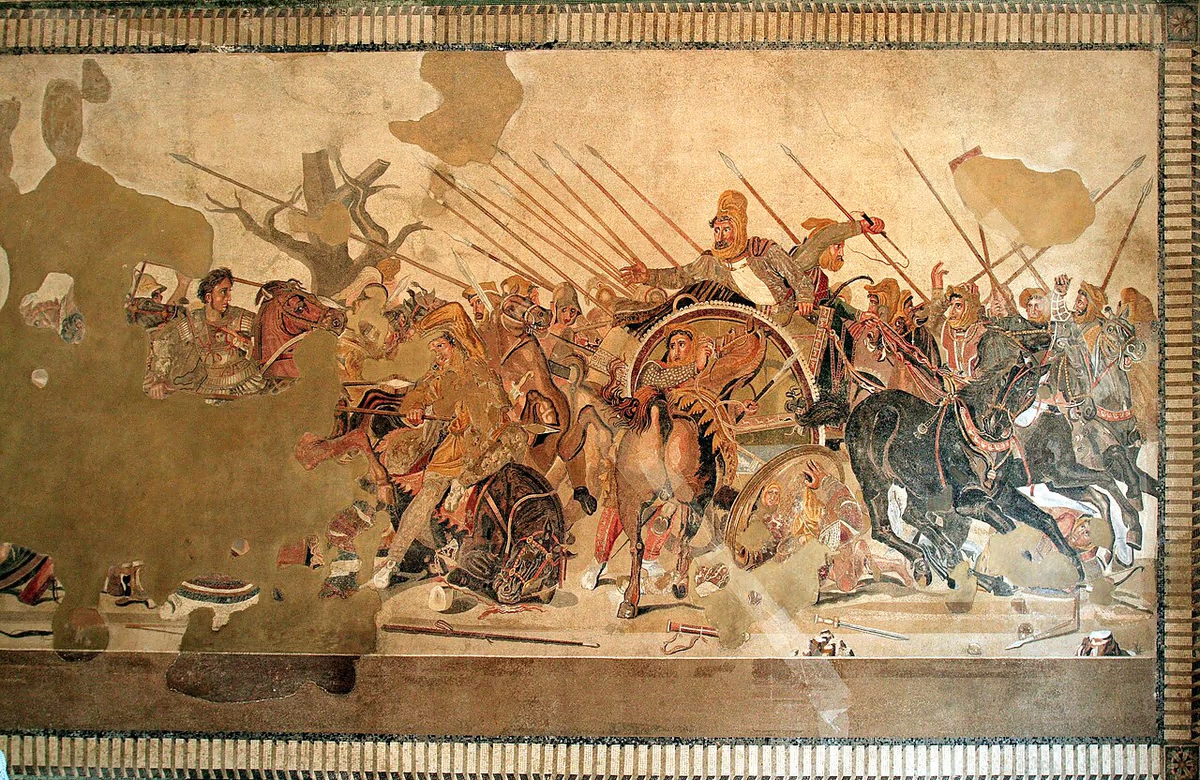
Unknown artist, Alexander Mosaic from the House of the Faun, Pompeii, c. 100 BC — National Archaeological Museum, Naples — photograph Magrippa, CC BY-SA 3.0 (Wikimedia Commons)
Alexander the Great vs Genghis Khan: Who Was Greater?
Alexander never lost a battle and died at 32; Genghis Khan started with nothing and built an empire that outlived him. Two conquerors compared on the record.
Fifteen centuries separate them, and they never fought each other. Yet the question keeps being asked: who was the greater conqueror, Alexander the Great or Genghis Khan? A fair answer has to start by admitting that “greater” means several different things. Alexander has the more spectacular battlefield record. Genghis Khan has the larger and longer-lived achievement. Which one counts more depends on what you think a conqueror is supposed to leave behind.
What follows compares the two men on five points the sources let us measure: where they started, how their armies worked, how they fought, how they governed, and what happened when they died.
Two very different starting points
Alexander was born in 356 BC at Pella, the son of Philip II of Macedon. He was taught by Aristotle at Mieza, alongside the sons of the Macedonian nobility, among them the future king Ptolemy. At eighteen he led the left wing of his father’s army at Chaeronea in 338 BC. When Philip was assassinated in 336, Alexander became king at twenty and inherited almost everything a conqueror needs: a trained professional army, a treasury, a network of officers, and a war against Persia that his father had already planned and announced.
Temüjin, the future Genghis Khan, was born around 1162 on the banks of the Onon, in what is now Mongolia; historians also propose 1155 or 1167. His father Yesügei, a minor Mongol chief, was poisoned by Tatars while Temüjin was still a boy, and the clan abandoned the widow and her children. The Secret History of the Mongols, the main Mongol source, describes years of poverty, the killing of his half-brother Begter, the abduction of his wife Börte by the Merkits, and defeats along the way: he was beaten by his former blood brother Jamukha, and in 1203 he was routed by his old patron Toghrul and had to regroup with a handful of loyal men at Baljuna.
He was proclaimed Genghis Khan at an assembly at the source of the Onon in 1206, at about forty-four if the 1162 date is right. At that age, Alexander had been dead for twelve years. That difference in starting point is the first thing to keep in mind: Alexander perfected a machine he was handed, while Temüjin had to assemble his from scattered and often hostile clans.
Two armies, two principles
Alexander crossed the Hellespont in 334 BC with an army estimated between roughly 35,000 and 50,000 men, depending on the ancient account. Its core was Philip’s creation: the phalanx of infantry armed with the long sarissa pike, and the heavy Companion cavalry that Alexander himself led in the charge. Around them were Greek allies, mercenaries, Thracian and Illyrian contingents, and engineers capable of long sieges.
Genghis Khan’s army was almost entirely mounted, but its real novelty was organisational. In 1206 he reorganised the steppe peoples into units of ten, a hundred, a thousand and ten thousand men. Each unit also included the households that supported it, so the army and society became the same structure. He deliberately broke up old tribal groupings and gave command on merit: his generals Jelme and Subutai were sons of blacksmiths. His personal guard grew from 1,150 to 10,000 men and became the training ground of his officers.
The contrast is telling. Alexander’s army was the finest instrument of its time, but it was held together by one man’s prestige; Genghis Khan’s was a system designed to work without him.
How they fought
Alexander sought the decisive battle and the enemy king. At the Granicus in 334, at Issus in 333 and at Gaugamela in 331, he aimed his cavalry at the point where the Persian command stood, and Darius III fled twice. He also took cities that refused to open their gates: Tyre resisted for seven months in 332 before falling. In India he defeated King Porus at the Hydaspes in 326. He was never beaten in a battle he commanded in person; the one serious defeat of his reign, at the Polytimetus in 329, struck a detachment sent without him.
Genghis Khan rarely needed a single great battle. He fought across wide fronts and delegated: Muqali ran the war in northern China while the khan was in Central Asia. Against the Western Xia in 1209, he broke a stalemate with a feigned retreat that drew the enemy out of its positions. In 1215 his armies took Zhongdu, the Jin capital near modern Beijing. In 1219, after the governor of Otrar massacred a caravan of merchants sent by Genghis Khan and the Khwarazmian shah had one of his envoys killed, he invaded Central Asia: while his sons besieged Otrar, he crossed the Kyzylkum desert to fall on Bukhara from the rear. Meanwhile Jebe and Subutai rode some 7,500 kilometres around the Caspian Sea, as far as Georgia and the lands of Kievan Rus’.
The older article on the site about the greatest conquerors and their methods describes both styles in more detail. The difference here is one of scale: Alexander won battles; Genghis Khan ran campaigns on several fronts at once, thousands of kilometres apart.
Cruelty: what can be said with confidence
Neither man fits the image of a merciful conqueror, and comparing them on this point requires caution with numbers.
Alexander razed Thebes in 335 BC after its revolt. After the fall of Tyre, according to the Roman historian Curtius Rufus, two thousand defenders were crucified along the shore. In 330 he let his troops loot Persepolis, and the palace burned. He also killed his own officer Cleitus, who had saved his life at the Granicus, during a drunken quarrel at Maracanda.
Genghis Khan made terror a method. In the Khwarazmian campaign, the cities that resisted were destroyed: Nishapur, Merv and Herat, among the largest and richest cities of their time, were annihilated. Persian chroniclers gave death tolls in the millions for single cities, figures modern historians regard as grossly exaggerated. Even so, the total cost of the Mongol conquests in human lives was enormous, and Genghis Khan’s campaigns account for a large part of it.
The honest conclusion is that the scale differs more than the logic. Both used massacre to make the next city surrender; the Mongol wars simply covered far more ground and far more people.
Governing what they took
Alexander kept the Persian system of satrapies, often with Persian governors, and adopted parts of the Persian court ceremonial, to the anger of many Macedonians. At Susa in 324 BC he organised a mass wedding of his officers with Iranian noblewomen. He founded cities, the most famous being Alexandria in Egypt, established in 331. But he spent almost his whole reign on campaign. After the army mutinied at the Hyphasis and the march back through the Gedrosian desert, he had barely two years left to rule.
Genghis Khan built institutions designed to outlast him. He had Mongolian written down in the Uyghur script, which gave the empire written records, and he reorganised justice under a supreme judge, Shigi Qutuqu; the written code later called the Great Yasa, by contrast, is probably not his work. He relied on foreign specialists, from Chinese engineers to Muslim administrators, and generally left religions alone as long as their followers submitted. His successors added a network of relay stations, the yam, that ran across Eurasia.
The succession test
This is where the comparison is most decisive. Alexander died at Babylon in June 323 BC, aged thirty-two, without an adult heir. His son Alexander IV was born after his death, and his half-brother Philip III Arrhidaeus was considered unfit to rule. The two were named joint kings, and both were murdered within a few years as the generals fought over the empire. It broke into rival kingdoms: the Seleucids in Asia, the Antigonids in Macedonia, and the Ptolemies in Egypt, whose last ruler was Cleopatra VII.
Genghis Khan settled the question while he was alive. When his sons Jochi and Chagatai quarrelled openly over the succession, he chose his third son, Ögedei. He died in August 1227 during a campaign against the Western Xia, after a fall from his horse while hunting the previous winter; his burial place was kept secret and has never been found. After a two-year interregnum, Ögedei was enthroned in 1229, and the empire kept growing for half a century. It became the largest contiguous state in history, stretching from the Sea of Japan to Eastern Europe, before dividing into separate khanates in the 1260s.
What each left behind
Alexander’s political empire did not survive him, but the world he opened did. Greek became a common language from Egypt to Bactria for centuries, and the city he founded in Egypt became the intellectual capital of the Mediterranean: it was still there, seven centuries later, that Hypatia taught mathematics and philosophy. Rulers kept measuring themselves against him. Julius Caesar, according to Suetonius, sighed before a statue of Alexander in Spain because he had done nothing memorable at an age when Alexander had already conquered the world, and Napoleon placed him among the commanders to study, as the article on who Napoleon admired shows.
Genghis Khan’s legacy is more physical. His grandson Kublai ruled China, where Marco Polo arrived at his court in 1275. Ibn Battuta, in the following century, travelled through khanates still ruled by his descendants. The Mughal dynasty of India claimed him as an ancestor: its founder Babur, grandfather of Akbar, descended from Genghis Khan through his mother. The Mongol conquests killed on a vast scale, and they also connected China, Iran and Europe more closely than ever before. In Mongolia itself, he is remembered as the founder of the nation.
So who was greater?
It depends on the criterion, and the honest answer is to name it.
- As a battlefield commander, Alexander has the stronger case: undefeated in the battles he led, almost always in person, often against larger armies, in barely eleven years of campaigning.
- As a builder, Genghis Khan has it: he started from nothing, lost battles and came back, and left a political and military system that kept expanding for fifty years after his death.
- On durability, the answer splits. Genghis Khan’s state lasted; Alexander’s culture did.
The two men are often lumped together as “the greatest conquerors in history”, but they represent two different ideas of conquest. One shows what a single exceptional leader can achieve with an inherited instrument; the other shows how to build an instrument that no longer needs its founder. For a comparison of Alexander with a modern conqueror, see Napoleon vs Alexander the Great.
Read Next

Greatest Conquerors in History and How They Won
Alexander, Genghis Khan, Caesar, Napoleon. The tactics that built the largest empires in history, and the mistake that brought each of them down.
20min read

Julius Caesar vs Napoleon: Who Was the Greater General?
Napoleon admired Caesar and called himself “of Caesar’s race.” Compare Alesia and Austerlitz, their tactics, defeats and what each empire left behind.
17min read

Charlemagne vs Napoleon: Two Attempts to Unite Europe
A thousand years apart, both crowned emperor, both trying to rebuild Rome. How each built his empire, and why neither one lasted.
16min read
Napoleon vs Alexander the Great: Who Was Greater?
Alexander never lost a battle; Napoleon won more of them. Compare their campaigns, their empires, and how each one ambition finally outran him.
12min read