Ibn Battuta (1304 – 1368/1369)
Quick Summary
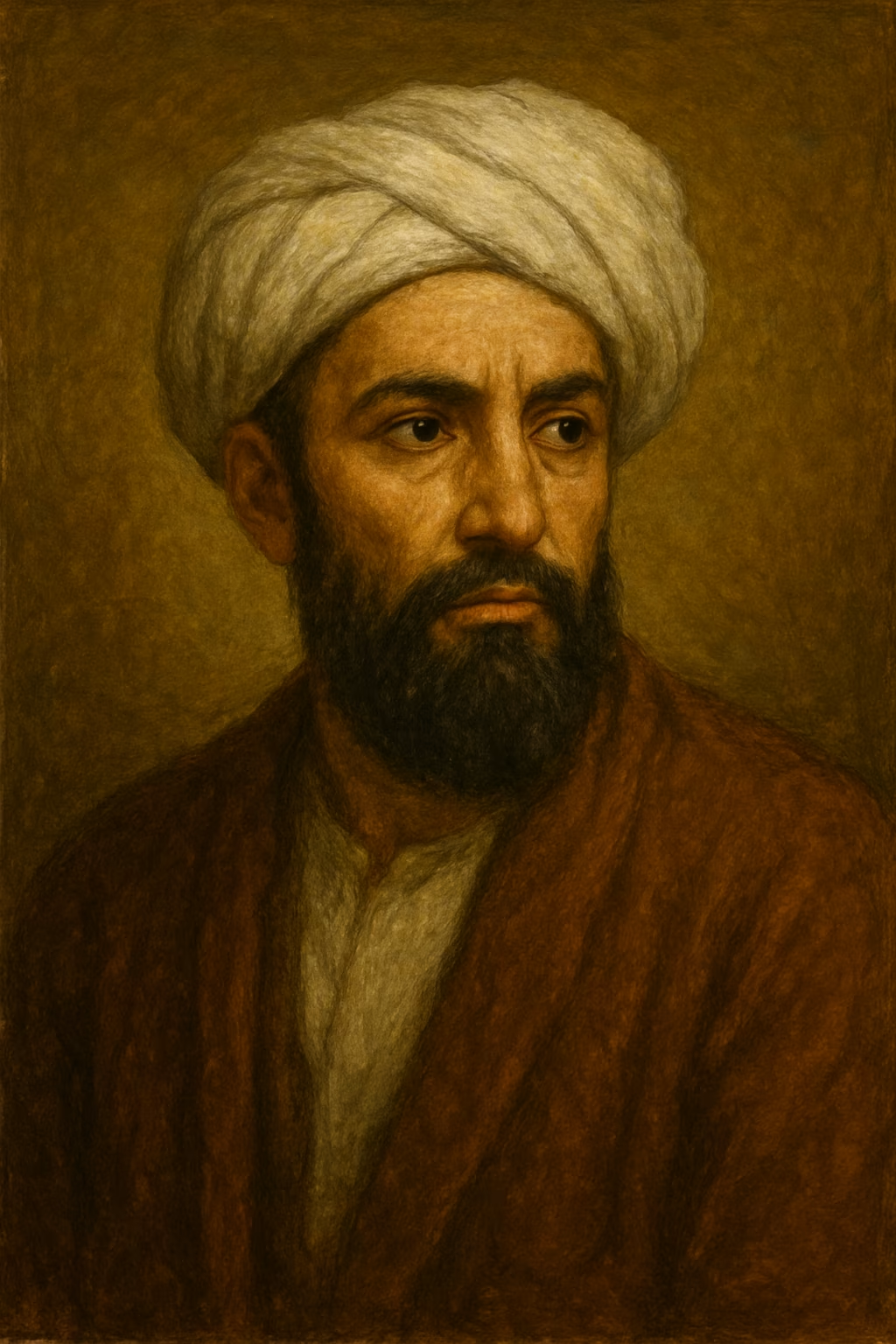
Ibn Battuta (1304 – 1368/1369) was a traveler and major figure in history. Born in Tangier, Marinid Morocco, Ibn Battuta left a lasting impact through Journeys of over 120,000 kilometers across Afro-Eurasia.
Birth
February 25, 1304 Tangier, Marinid Morocco
Death
1369 Likely Fez, Marinid Morocco
Nationality
Moroccan
Occupations
Complete Biography
Origins And Childhood
Born in Tangier in 1304 to a family of Berber Lawata jurists trained in Maliki law, Ibn Battuta grew up in a bustling port connected to Atlantic and Mediterranean trade. His early education centered on fiqh, Arabic grammar, and Qur’an memorization. Like many Marinid scholars, he sought to complete his training with a pilgrimage to Mecca to meet renowned teachers in the Hejaz. Early-14th-century Tangier linked Nasrid Granada and the Marinid Maghreb, exposing him to caravans and pilgrims. In 1325, at twenty-one, he set out for the hajj, unaware this would launch a lifetime of travel.
Historical Context
Afro-Eurasia in the 14th century saw expanding trans-Saharan, Indian Ocean, and Silk Road exchanges. Marinids in the Maghreb, Mamluks in Egypt, Ilkhanids then Jalayirids in Iran, Timurids in Central Asia, and the Yuan in China framed a fragmented but interconnected Islamic world. The Black Death (1347–1352) disrupted populations and routes. Scholars traveled widely to teach and collect ijaza. Sultans prized these scholarly networks for prestige. Ibn Battuta tapped into madrasas and khanqahs for lodging and work, gaining rare appointments far from home.
Public Ministry
After completing his first hajj in 1326, Ibn Battuta pushed on to Iraq, Persia, and Anatolia, visiting Sufi lodges and courts. He performed at least three full pilgrimages and spent extended periods in the holy cities. His Maliki legal training earned temporary qadi roles, particularly under the Mamluks. As he accumulated ijaza and letters of introduction, his reputation grew. Hospices granted horses and stipends, and Sufi networks like the Shadhiliyya aided his mobility. These experiences forged his identity as a learned traveler bridging legal schools and cultures.
Teachings And Message
While not a preacher, Ibn Battuta promoted Maliki orthodoxy and Sufi piety. He emphasized hospitality, mutual aid among travelers, and the sharing of knowledge. His observations detail court ceremonies, marriage contracts, waqf administration, market regulation, and qadi procedures, offering a granular view of medieval Islamic society. His narrative carries moral overtones: he praises communities that support learning and criticizes predatory taxation or unsafe routes. Frequent Qur’anic and hadith references lend didactic weight to his encyclopedic travelogue.
Activity In Galilee
On his first pilgrimage, Ibn Battuta passed through Mamluk Syria, noting Damascus, Aleppo, and the Galilean plateau. He observed abandoned Crusader fortresses, busy khans, and abundant waqf-funded fountains and schools—evidence of vibrant urban life under the Mamluks. His comments link sacred geography with infrastructure, highlighting how hajj routes structured regional economies.
Journey To Jerusalem
He visited Jerusalem in 1326, praising restorations to the Dome of the Rock and the scholarly life around al-Aqsa. Although he reports no direct conflict, he notes tensions among Christian and Muslim communities at shared shrines. His focus on security charters (aman) illustrates his legal lens and concern for traveler safety.
Sources And Attestations
The primary source is the "Rihla" dictated to Ibn Juzayy around 1355, combining personal memory with earlier travel literature. Corroboration from Mamluk documents, Persian chronicles, and Chinese accounts (e.g., on Quanzhou) supports many legs of his route. Scholars such as Gibb, Dunn, and Levtzion debate embellishments, but overall consistency remains. Maghrebi and Algerian manuscripts from the 15th century show the text’s early circulation. European translations in the 19th century revived interest, cementing his status as a premodern global traveler.
Historical Interpretations
Historians question certain episodes—his presence at the Yuan court or details of the Maldives—but generally accept his travels to India, Sri Lanka, and Southeast Asia, including service to Sultan Muhammad ibn Tughluq as qadi and envoy. The "Rihla" functions as scholarly self-legitimation, celebrating Islamic universality, Sufi solidarity, and the intellectual weight of the Maghreb. It remains central for understanding 14th-century legal, commercial, and spiritual networks across Afro-Eurasia.
Legacy
Returning to Morocco in 1354, Ibn Battuta delivered his account to Sultan Abu Inan Faris. The "Rihla" shaped later Arabic cartography and fed European visions of the East after translation. Today he epitomizes the learned traveler and the interconnectedness of the medieval Islamic world. Museums, airports, and heritage routes bear his name, and his testimony informs global history of mobility and diplomacy across the Indian Ocean and Sahara.
Achievements and Legacy
Major Achievements
- Journeys of over 120,000 kilometers across Afro-Eurasia
- Service as qadi in several courts, including Delhi and the Maldives
- Detailed description of trans-Saharan and Indian Ocean trade routes
- Dictation of the "Rihla", a key source on the 14th-century Islamic world
Historical Legacy
Ibn Battuta stands as a symbol of medieval Islamic scholarly mobility. His narrative links the Maghreb, Sahelian Africa, the Middle East, the Indian Ocean, and China, offering a rare view of Afro-Eurasian connectivity before modern globalization. The "Rihla" still informs historical research, cultural mapping, and contemporary heritage tourism.
Detailed Timeline
Major Events
Birth
Born in Tangier to a family of Maliki jurists
Departure for the hajj
Leaves Tangier for Mecca, beginning 24 years of travel
Arrival in Delhi
Appointed qadi by Sultan Muhammad ibn Tughluq
Mission to China
Embarks on an embassy bound for Quanzhou and Hangzhou
Journey to Mali
Crosses the Sahara to Mansa Suleyman’s court
Return to Fez
Dictates the "Rihla" to Ibn Juzayy
Geographic Timeline
Famous Quotes
"I have indeed seen the world, and nowhere did I find hospitality like that of the Indus valley."
"Travel leaves you speechless, then turns you into a storyteller."
"Sea routes are ruled by winds just as desert roads are ruled by water."
External Links
Frequently Asked Questions
When was Ibn Battuta born and when did he die?
He was born February 25, 1304, in Tangier and likely died around 1368/1369 under the Marinids in Morocco.
Why is he famous?
For traveling over 24 years across Afro-Eurasia and for his travelogue, the "Rihla", which documents 14th-century cities, trade routes, and legal customs.
Which territories did he visit?
From the Maghreb and al-Andalus to sub-Saharan Africa, Arabia, Persia, Central Asia, India, Sri Lanka, Southeast Asia, China, Anatolia, and the Black Sea.
What was his profession?
Trained as a Maliki jurist, he served as qadi and envoy for various rulers, which secured hospitality and appointments during his travels.
What is the main source on his life?
The "Rihla" (Travel), dictated to the Andalusian scholar Ibn Juzayy in Fez around 1355 at the request of Sultan Abu Inan Faris.
Sources and Bibliography
Primary Sources
- Ibn Battûta — Rihla (Tuhfat al-Nuzzar)
- Ibn Juzayy — Compilation de la Rihla
Secondary Sources
- Ross E. Dunn — The Adventures of Ibn Battuta ISBN: 9780520259447
- H.A.R. Gibb — The Travels of Ibn Battuta ISBN: 9781107668750
- Nehemia Levtzion — Islam in West Africa ISBN: 9780801406670
- Richard W. Bulliet — The Camel and the Wheel ISBN: 9780231067314
- Jean-Louis Miège — Le Maroc et l’Europe (XIIIe–XVe siècles) ISBN: 9782713218120
- Françoise Micheau — La Médecine arabe et l’Occident médiéval ISBN: 9782713228303
- UNESCO — Voyages et découvertes d’Ibn Battûta
- C. F. Beckingham — Notes on Ibn Battuta’s Travels
External References
See Also
Related Figures

Specialized Sites
Batailles de France
Discover battles related to this figure
Dynasties Legacy
In preparationFuture site on royal and noble lineages (not available yet)
Timeline France
In preparationFuture chronological timeline site (not available yet)