Galileo Galilei (1564 – 1642)
Quick Summary
Galileo Galilei (1564 – 1642) was a astronomer and major figure in history. Born in Pisa, Duchy of Florence (present-day Italy), Galileo Galilei left a lasting impact through First systematic scientific use of the telescope, which he improved to a magnification of about thirty.
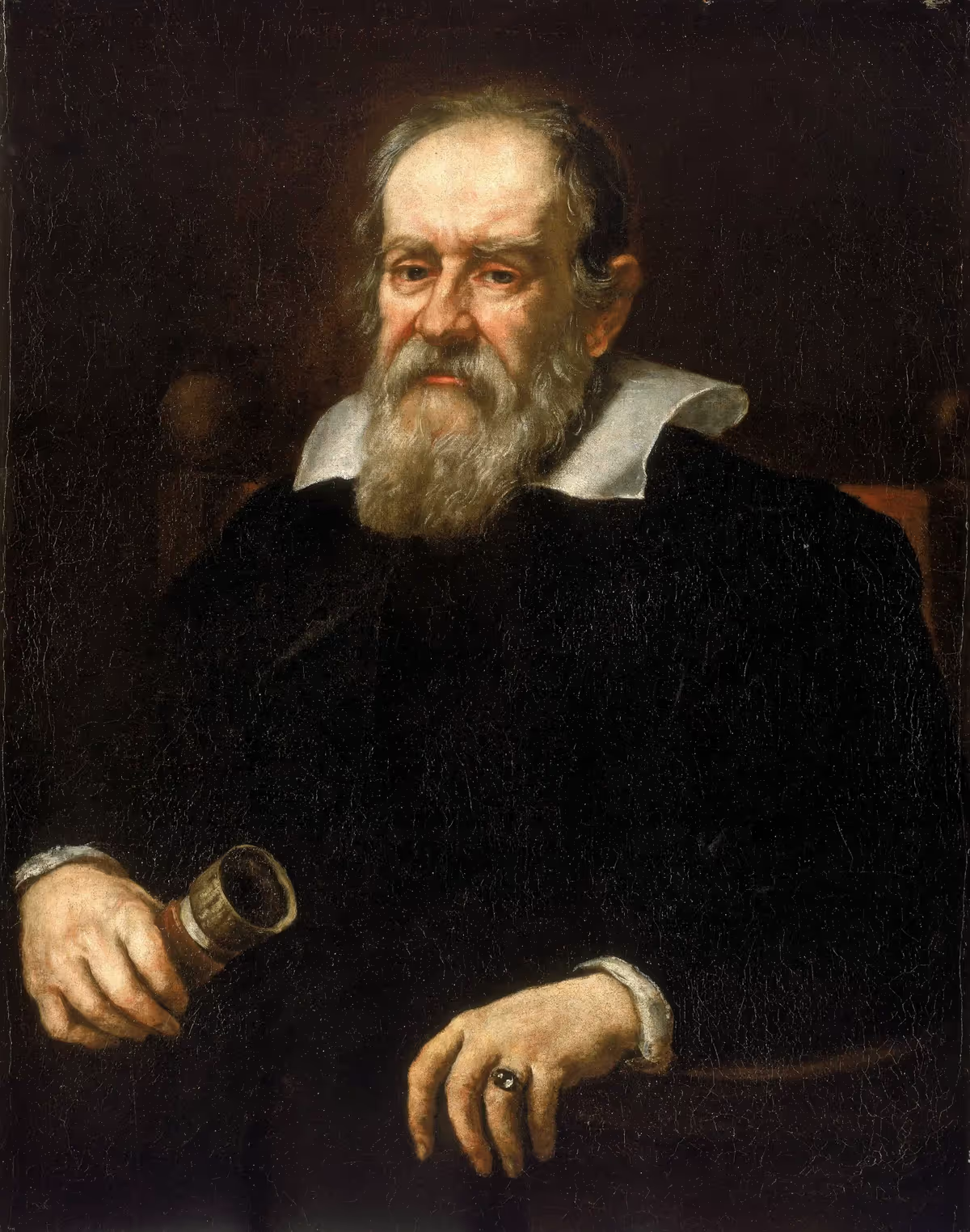
Justus Sustermans, Portrait de Galilée, entre 1636 et 1640 — National Maritime Museum, Greenwich (Royal Museums Greenwich) — domaine public (Wikimedia Commons)
Birth
February 15, 1564 Pisa, Duchy of Florence (present-day Italy)
Death
January 8, 1642 Arcetri, near Florence, Grand Duchy of Tuscany
Nationality
Tuscan
Occupations
Complete Biography
A Youth Between Pisa And Florence
Galileo Galilei was born in Pisa on 15 February 1564, three days before Michelangelo died and in the same year as William Shakespeare. Pisa then belonged to the Duchy of Florence, ruled by the Medici. His father, Vincenzo Galilei, a lutenist and music theorist, published in 1581 a Dialogue on Ancient and Modern Music, part of a heated controversy over musical theory. The family, minor Florentine nobility of modest means, moved to Florence. There Galileo was schooled at the monastery of Vallombrosa, where he wore a novice's habit until the age of fourteen. His father wanted a profession for him that paid a living: medicine. Around 1580 the young man enrolled at the University of Pisa. But from about 1583 Ostilio Ricci, a family friend trained in the school of Tartaglia, had him read Euclid and Archimedes. Galileo let medicine go and left Pisa in 1585 without a degree.
The Pisa Professor
The next few years were those of a mathematician without a post. Galileo gave private lessons in Florence and Siena, and in 1586 wrote a short treatise, La Bilancetta, on a hydrostatic balance inspired by Archimedes, which brought him to the notice of scholars. In 1587 he travelled to Rome to ask Christopher Clavius, the leading Jesuit mathematician, for a recommendation to the chair at Bologna; he did not get it. In 1588 he gave two lectures to the Florentine Academy on the shape, location and size of Dante's Inferno, an exercise in geometry applied to poetry, and taught perspective and chiaroscuro at the Florentine Academy of Design. In 1589 he finally obtained the chair of mathematics at Pisa. There, around 1590, he wrote a De motu that he never published, attacking Aristotle's physics of falling bodies. His disciple Vincenzo Viviani dated to these years the famous experiment of balls dropped from the Leaning Tower; no document from the time confirms it. In 1591 his father's death left him responsible for his mother, his younger brother Michelagnolo and his sisters' dowries.
Eighteen Years In Padua
In 1592 Galileo moved to the University of Padua, in the Republic of Venice, where he taught geometry, mechanics and astronomy until 1610. His salary was not enough: he took in student lodgers, gave private lessons and had his workshop build a geometric and military compass, a calculating instrument for gunners and surveyors whose instructions he published in 1606. He also obtained a patent from the Republic for a water-raising machine. Above all, Padua was where he did his research on motion. Using inclined planes and pendulums, he established that the distance covered by a falling body grows as the square of the time elapsed, and that the period of a pendulum does not depend on the amplitude of its small swings. This work would not be published until 1638. In 1604 a new star appeared in the sky; finding no parallax, Galileo placed it far beyond the Moon, in heavens that Aristotle had held to be unchanging. He was living at the time with a Venetian woman, Marina Gamba, who bore him three children out of wedlock: Virginia in 1600, Livia in 1601 and Vincenzo in 1606.
The Telescope And The Starry Messenger
In 1609 Galileo heard that a Dutch spectacle-maker had produced a tube that made distant objects look closer. Without having seen the device, he built one that magnified about three times, then increasingly powerful models, up to about thirty times. On 25 August 1609 he presented his telescope to the Venetian government, which saw its military value, doubled his salary and offered him a post for life. On 30 November he turned it on the Moon and explained the jagged line between shadow and light: the Moon had mountains, whose height he estimated from the shadows they cast. On 7 January 1610 he noticed three small "stars" in a line near Jupiter; on the following nights they changed position and a fourth appeared. They were four satellites orbiting the planet. On 12 March 1610 the Sidereus Nuncius (Starry Messenger) appeared in Venice, the first treatise based on observations through a telescope. Galileo dedicated the satellites to the Grand Duke of Tuscany, Cosimo II, his former pupil, naming them the "Medicean stars".
Florence Venus And The Sunspots
The dedication paid off. In 1610 Galileo left Padua to become chief mathematician of the University of Pisa, with no duty to teach, and mathematician and philosopher to the Grand Duke; he insisted on the second title, which made him a student of nature rather than a mere calculator. He left Marina Gamba behind in Padua; his two daughters later entered the convent of San Matteo at Arcetri, near Florence, where Virginia took the name Sister Maria Celeste. From September 1610 he observed that Venus shows a full set of phases, like the Moon: exactly what the Copernican system predicts and what Ptolemy's cannot produce. He also saw Saturn flanked by two "companions", later identified as its rings. In the spring of 1611, in Rome, the Jesuit astronomers of the Collegio Romano confirmed his observations, and Prince Federico Cesi welcomed him into the Accademia dei Lincei. In 1613 the academy published his History and Demonstrations Concerning Sunspots, a reply to the Jesuit Christoph Scheiner: the spots lay on the surface of the Sun, which rotated on its axis.
The Bible And The Ban Of 1616
In December 1613 the Dowager Grand Duchess Christina of Lorraine put to Benedetto Castelli, a disciple of Galileo, the passages of the Bible in which the Sun moves. Galileo replied with a letter to Castelli and then, in 1615, with a long Letter to the Grand Duchess Christina: Scripture speaks the language of ordinary people in order to teach salvation, and cannot settle a question that observation and demonstration are able to resolve. But a Dominican friar, Niccolò Lorini, had already passed his writings to the Roman Inquisition. In February 1616 a commission of theologians declared the immobility of the Sun "foolish and absurd in philosophy, and formally heretical". On the orders of Pope Paul V, Cardinal Robert Bellarmine summoned Galileo on 26 February and instructed him to abandon the opinion. On 5 March the Congregation of the Index suspended Copernicus's De revolutionibus "until corrected" and banned books defending the motion of the Earth. Galileo, who was not named, fell silent on the subject. He kept, however, his theory of the tides, written that same year for Cardinal Orsini, which he believed proved the Earth's double motion; it was wrong.
From The Assayer To The Trial Of 1633
A quarrel over the comets of 1618 set him against the Jesuit Orazio Grassi of the Collegio Romano. Galileo answered in 1623 with Il Saggiatore (The Assayer), in which he wrote that the book of nature is written in the language of mathematics. The work was dedicated to the new pope, Urban VIII, formerly Cardinal Maffeo Barberini, who had admired Galileo and disapproved of the 1616 admonition. Encouraged, Galileo wrote a dialogue on the two chief world systems, on condition that it set out both views without deciding between them. Published in Florence in 1632, the Dialogue has three speakers: Salviati, Galileo's spokesman; Sagredo, an open mind; and Simplicio, Aristotle's defender, who often comes off worst. The book read as a defence of Copernicus, and the pope felt himself targeted. Summoned to Rome as early as September 1632, Galileo did not arrive until February 1633. Before the inquisitor Vincenzo Maculani, he maintained that he had respected the 1616 injunction. On 22 June 1633 the sentence declared him "vehemently suspect of heresy"; kneeling, he had to abjure, curse and detest his opinions. The next day his imprisonment was commuted to house arrest, and the Dialogue was banned.
Arcetri And The Two New Sciences
Galileo first spent a few months in Siena with Archbishop Ascanio Piccolomini, who received him as a friend. In December 1633 he was confined to his villa, Il Gioiello, at Arcetri, close to his daughters' convent; the sentence required him to recite the penitential psalms every week, and Maria Celeste obtained permission to say them in his place. She died on 2 April 1634, aged thirty-three. Barred from publishing, Galileo returned to the research of his Padua years. The manuscript of his Discourses and Mathematical Demonstrations Relating to Two New Sciences went to Holland, beyond the reach of Roman censorship, and was printed in Leiden by Louis Elzevir in 1638. The two sciences are the strength of materials and the science of motion: uniformly accelerated fall and the parabolic path of projectiles. Galileo also described an attempt to measure the speed of light with two lanterns. Since January 1638 he had been completely blind. His last disciples, Vincenzo Viviani and Evangelista Torricelli, were with him when he died at Arcetri on 8 January 1642, aged seventy-seven.
Achievements and Legacy
Major Achievements
- First systematic scientific use of the telescope, which he improved to a magnification of about thirty
- Discovery of the four large moons of Jupiter in January 1610, published in the Sidereus Nuncius
- Observation of the Moon's relief, the phases of Venus and sunspots, decisive arguments against the cosmos of Aristotle and Ptolemy
- Law of falling bodies: the distance covered grows as the square of the time
- Isochronism of a pendulum's small swings and the parabolic path of projectiles
- Principle of the relativity of motion, set out in the 1632 Dialogue with the image of the ship
- Founding of the science of the strength of materials in the Two New Sciences (1638)
Historical Legacy
It was long said that, as he rose after his abjuration, Galileo muttered "Eppur si muove" ("And yet it moves"). The earliest written account of the scene dates from a century after his death: it is a legend, though one that captures what posterity remembered. The Church revised its position in stages. In 1718 his works could be reprinted, except the Dialogue; in 1741 Benedict XIV allowed a complete edition with a lightly censored Dialogue; in 1758 the general ban on heliocentric books was lifted, and in 1835 the Dialogue and De revolutionibus disappeared from the Index. On 31 October 1992 John Paul II acknowledged that the theologians who condemned him had been wrong. Historians qualify the fable of the lone scientist against obscurantism: Galileo had had supporters up to the summit of the Church, and his proof from the tides was false. The fact remains that he changed the way physics is done, by asking measured experiment and mathematics what had been asked of texts. Albert Einstein regarded him as the father of modern physics. Isaac Newton, born less than a year after his death, would build his mechanics on the law of falling bodies and on the principle of inertia that Galileo had glimpsed. His remains were moved in 1737 to a monument in the Basilica of Santa Croce in Florence, and the four satellites he discovered are known today as the Galilean moons.
Detailed Timeline
Major Events
Birth
On 15 February, in Pisa, in the Duchy of Florence, son of the musician Vincenzo Galilei.
Medical studies
Around 1580 he enrolled at the University of Pisa to become a physician, as his father wished.
Medicine abandoned
Won over to mathematics by Ostilio Ricci, he left Pisa without a degree.
La Bilancetta
A short treatise on a hydrostatic balance, his first noticed work.
Chair at Pisa
He obtained the chair of mathematics at the University of Pisa.
Professor in Padua
He taught at the university of the Republic of Venice until 1610.
The new star
Finding no parallax, he placed the supernova far beyond the Moon.
The telescope
On 25 August he presented his telescope to the Venetian government; on 30 November he observed the Moon.
The Starry Messenger
Moons of Jupiter discovered on 7 January, Sidereus Nuncius published on 12 March, then a move to the Medici court in Florence.
Journey to Rome
The Jesuits of the Collegio Romano confirmed his observations; he joined the Accademia dei Lincei.
The sunspots
Publication of the History and Demonstrations Concerning Sunspots; letter to Benedetto Castelli on the Bible and science.
The admonition
On 26 February Cardinal Bellarmine instructed him to abandon heliocentrism; on 5 March the Index suspended Copernicus.
The Assayer
Publication of Il Saggiatore, dedicated to the new pope, Urban VIII.
The Dialogue
Publication in Florence of the Dialogue Concerning the Two Chief World Systems.
Trial and abjuration
On 22 June, condemned in Rome as "vehemently suspect of heresy", he abjured; confined to Arcetri in December.
Two New Sciences
Blind since January, he had his Discourses on the strength of materials and motion printed in Leiden.
Death
On 8 January, at Arcetri, with Viviani and Torricelli at his side.
Geographic Timeline
Famous Quotes
"Philosophy is written in this grand book, which stands continually open before our eyes, I mean the universe [...]. It is written in the language of mathematics, and its characters are triangles, circles and other geometric figures." — The Assayer, 1623.
"The intention of the Holy Spirit is to teach us how one goes to heaven, not how heaven goes." — Letter to the Grand Duchess Christina, 1615, a saying Galileo attributes to Cardinal Baronius.
External Links
Frequently Asked Questions
Who was Galileo?
Galileo Galilei (1564 – 1642) was a Tuscan astronomer, physicist and mathematician born in Pisa. A professor at Pisa and then Padua, and mathematician and philosopher to the Grand Duke of Tuscany from 1610, he is one of the founders of modern science, through both his telescopic observations and his laws of motion. Condemned by the Inquisition in 1633 for defending the Copernican system, he died under house arrest at Arcetri in 1642.
What did Galileo discover with his telescope?
From late 1609: the mountains and craters of the Moon, a multitude of stars invisible to the naked eye in the Milky Way, the four large moons of Jupiter (January 1610), the phases of Venus (from September 1610), the strange appearance of Saturn, whose rings he did not understand, and the spots on the Sun. Jupiter's moons and the phases of Venus were the two strongest arguments against the idea that everything revolves around the Earth.
Why was Galileo condemned?
In 1616 the Church had declared heliocentrism contrary to Scripture and Galileo had been ordered to abandon it. His 1632 Dialogue, meant to present both systems without deciding between them, read as a defence of Copernicus, and Pope Urban VIII, once his protector, felt he had been mocked. On 22 June 1633 the Inquisition declared him "vehemently suspect of heresy" and forced him to abjure. He was not tortured, although he was threatened with it at his final interrogation, and his prison sentence was commuted the next day to house arrest.
Did Galileo really say "And yet it moves"?
Nothing confirms it. The phrase "Eppur si muove" appears in no document from his lifetime nor in the trial records; the earliest written account dates from a century after his death. Spoken before the inquisitors just after kneeling to abjure, it would have exposed him to a far heavier sentence.
Did Galileo drop balls from the Leaning Tower of Pisa?
The episode is known only from the biography by his disciple Vincenzo Viviani, written after his death, and Galileo himself never mentions it. Historians consider it uncertain. What is established are his experiments with inclined planes and pendulums, through which he showed that, without air resistance, the fall does not depend on weight, and that the distance grows as the square of the time.
Sources and Bibliography
Primary Sources
- Galileo Galilei, Sidereus Nuncius (Venise, 1610)
- Galileo Galilei, Il Saggiatore (Rome, 1623)
- Galileo Galilei, Dialogo sopra i due massimi sistemi del mondo (Florence, 1632)
- Galileo Galilei, Discorsi e dimostrazioni matematiche intorno a due nuove scienze (Leyde, 1638)
Secondary Sources
- Stillman Drake, Galileo at Work: His Scientific Biography
- Maurice A. Finocchiaro, The Galileo Affair: A Documentary History
- J. L. Heilbron, Galileo
- Dava Sobel, Galileo's Daughter
- David Marshall Miller, « Galileo Galilei », Stanford Encyclopedia of Philosophy
External References
See Also
Related Figures
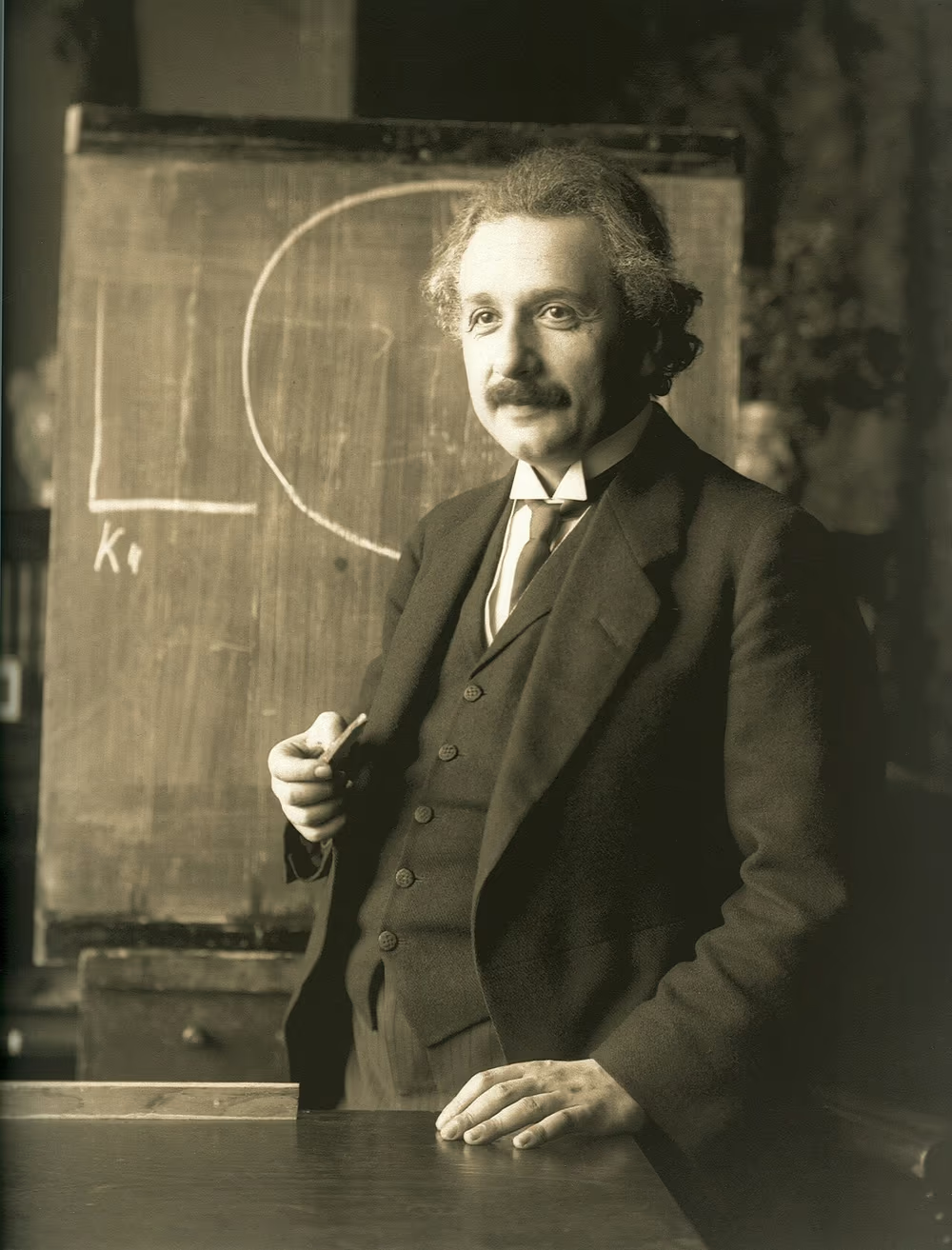
Albert Einstein
Theoretical Physicist
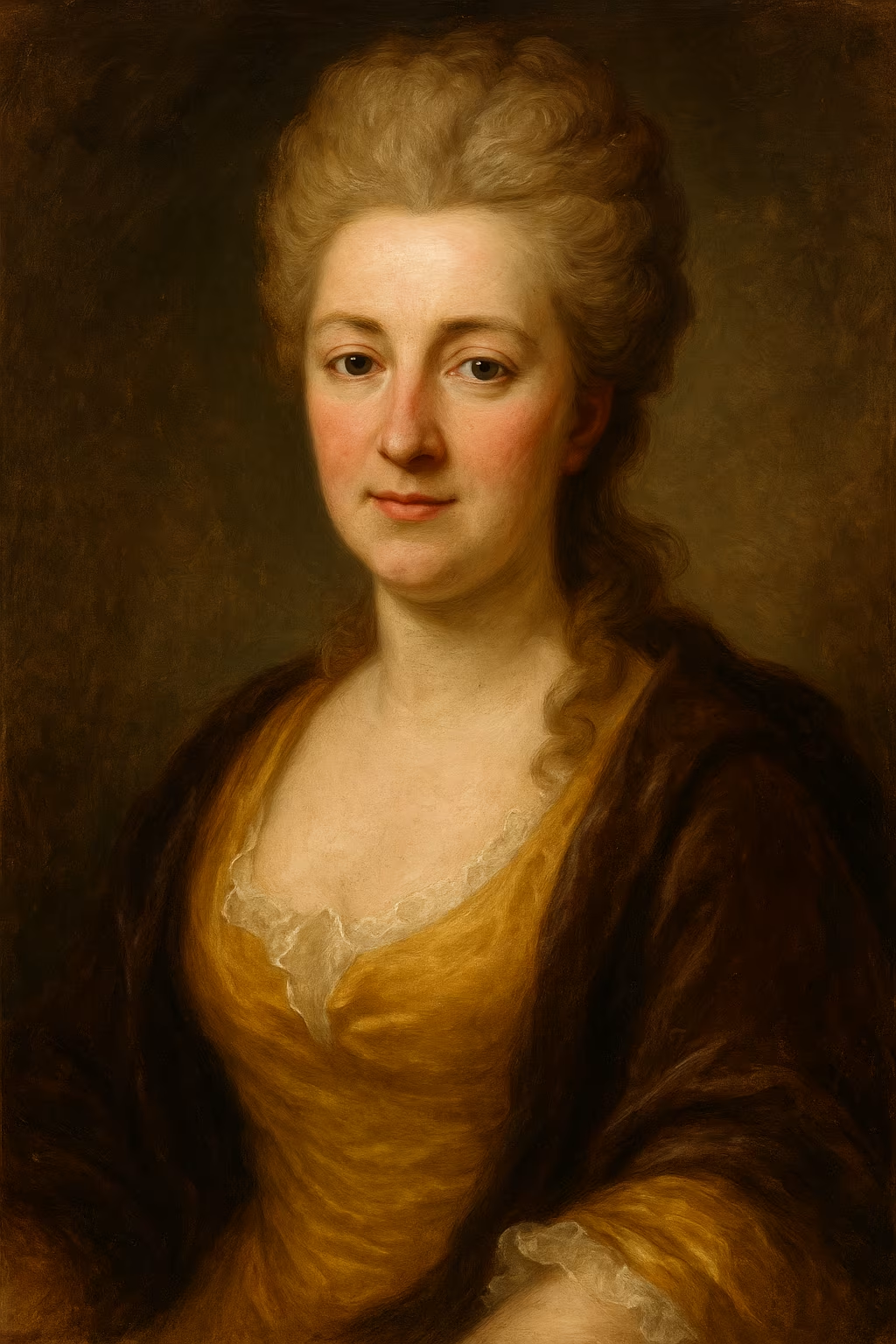
Émilie du Châtelet
Enlightenment mathematician, physicist, and philosopher
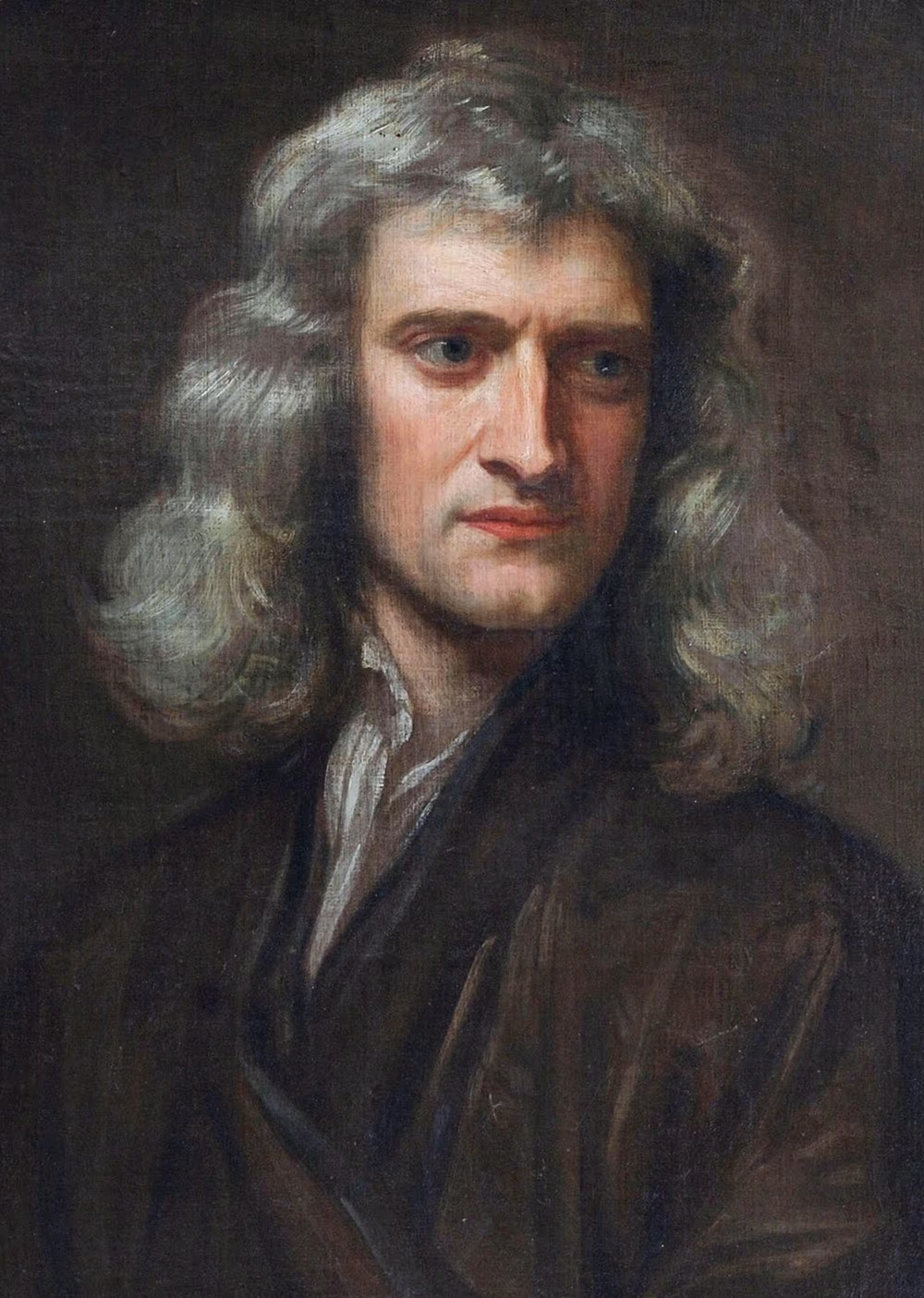
Isaac Newton
Mathematician, physicist, and natural philosopher of the seventeenth century
Leonardo da Vinci
Italian Renaissance artist, engineer, and polymath
Specialized Sites
Batailles de France
Discover battles related to this figure
Dynasties Legacy
In preparationFuture site on royal and noble lineages (not available yet)
Timeline France
In preparationFuture chronological timeline site (not available yet)