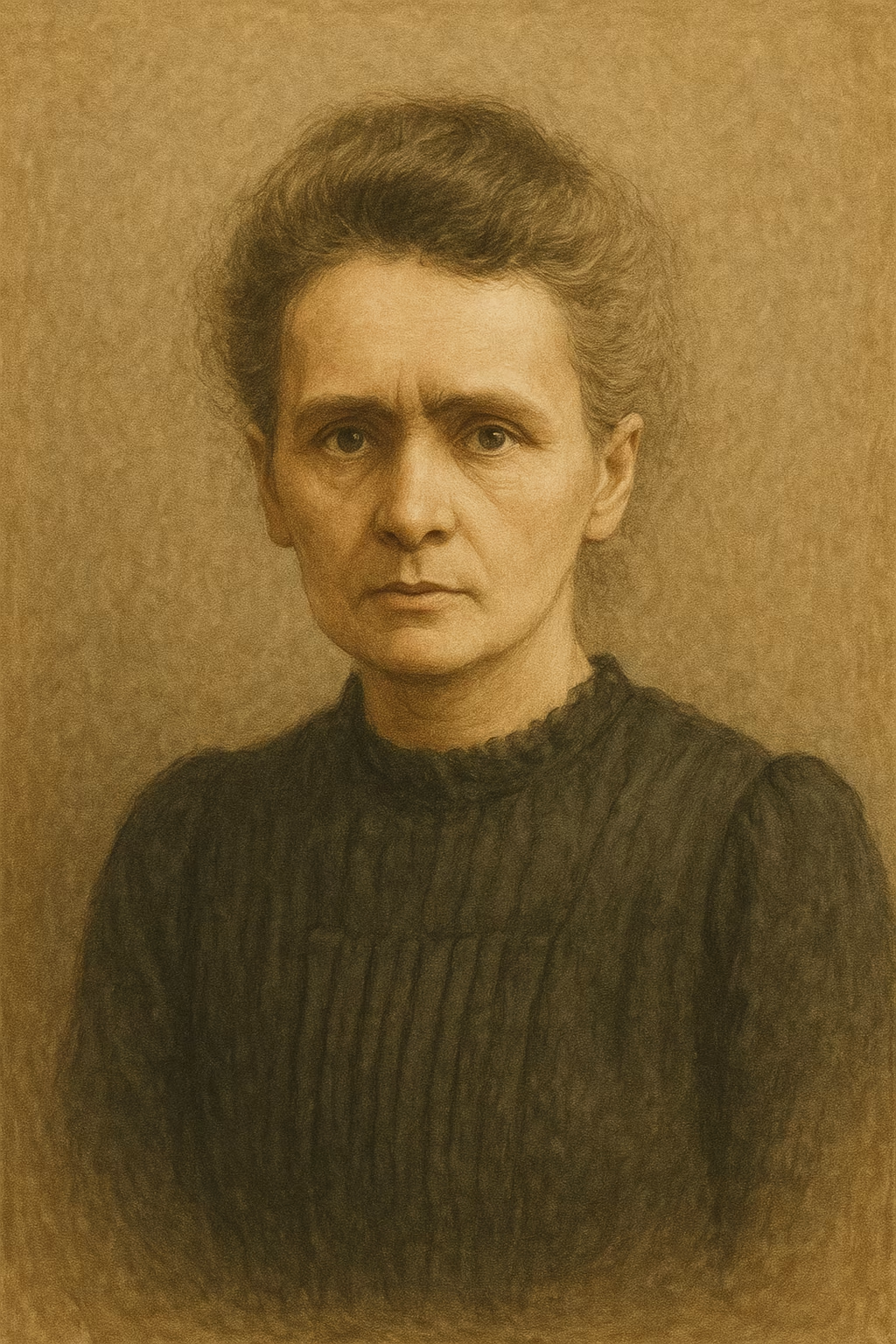
Why is Marie Curie So Important? The Legacy of a Science Pioneer
Discover why Marie Curie is a major figure in the history of sciences. Analysis of her revolutionary discoveries, her impact on modern medicine, and her role as a pioneer for women scientists.
Why is Marie Curie So Important? The Legacy of a Science Pioneer
Marie Curie (1867-1934) is one of the most important figures in the history of science. The first woman to receive a Nobel Prize and the only person to receive two in two different disciplines, she revolutionized our understanding of radioactivity and paved the way for modern nuclear medicine. This article explores the multiple reasons why her legacy remains fundamental today.
Introduction: An Exceptional Figure
Marie Curie represents much more than simply an exceptional scientist. She embodies perseverance in the face of adversity, scientific rigor, and the ability to transform the world despite social and cultural obstacles. Her importance far exceeds her scientific discoveries to encompass her role as a pioneer and model for future generations.
1. Revolutionary Scientific Discoveries
The Discovery of Radioactivity
Marie Curie, with her husband Pierre Curie, discovered two new chemical elements: polonium (named in honor of her native Poland) in 1898, and radium the same year. These discoveries revolutionized physics and chemistry, opening a new field of research.
The term “radioactivity” was actually invented by Marie Curie herself to describe this mysterious phenomenon she was studying. This fundamental discovery changed our understanding of matter and energy.
The Isolation of Pure Radium
One of her most remarkable achievements was the isolation of pure radium in 1910, after years of laborious work. She and Pierre processed tons of pitchblende (uranium ore) to extract tiny quantities of radium, demonstrating exceptional perseverance and rigor.
This isolation allowed better understanding of radium’s properties and opened the way to its medical applications, notably in cancer treatment.
Impact on Modern Physics
Marie Curie’s work on radioactivity prepared the ground for later discoveries in nuclear physics. Her research directly influenced scientists like Ernest Rutherford and Niels Bohr, who developed the theory of atomic structure.
2. Major Medical Impact
Radiotherapy Against Cancer
The discovery of radium revolutionized cancer treatment. Radium emits gamma rays that can destroy cancer cells. Marie Curie herself contributed to developing the first medical applications of radioactivity.
Today, radiotherapy saves millions of lives each year. Without Marie Curie’s discoveries, this essential medical technique would not exist.
Mobile Radiological Units
During World War I, Marie Curie developed mobile radiological units, nicknamed “Petites Curies.” These vehicles equipped with X-ray apparatus allowed surgeons to locate bullets and fractures on the battlefield, saving countless lives.
She personally trained hundreds of radiology technicians and supervised the installation of these units in field hospitals. Her humanitarian commitment demonstrated that science can directly serve humanity.
The Legacy of Nuclear Medicine
Marie Curie’s work founded modern nuclear medicine. Today, medical imaging techniques (scintigraphy, PET scan) and radioisotope treatments derive directly from her research.
3. A Pioneer for Women in Science
First Woman Nobel Prize Winner
In 1903, Marie Curie became the first woman to receive a Nobel Prize (Physics), shared with Pierre Curie and Henri Becquerel. This international recognition broke the glass ceiling for women scientists.
At a time when women were largely excluded from universities and scientific careers, this distinction demonstrated that talent has no gender.
Only Double Laureate in Sciences
In 1911, she received a second Nobel Prize, this time in Chemistry, for the isolation of radium and polonium. She remains to this day the only person to have received Nobel Prizes in two different scientific disciplines.
This double distinction is all the more remarkable as it was obtained in a context where women scientists were rare and often marginalized.
First Woman Professor at the Sorbonne
After Pierre Curie’s tragic death in 1906, Marie Curie succeeded him as professor at the Sorbonne, becoming the first woman to hold this prestigious position. This symbolic appointment opened the way for other women in higher education.
A Model for Future Generations
Marie Curie became a model for generations of women scientists. Her daughter Irène Joliot-Curie followed in her footsteps, also receiving a Nobel Prize in Chemistry in 1935. Today, many women scientists cite Marie Curie as a source of inspiration.
4. Scientific Rigor and Methodology
Exceptional Methodical Approach
Marie Curie’s work is characterized by exceptional methodical rigor. The isolation of radium required years of tedious work, manually processing tons of ore under difficult conditions.
This perseverance and rigor demonstrate the essential qualities of a great scientist: patience, precision, and determination in the face of obstacles.
The Importance of Scientific Collaboration
The scientific partnership between Marie and Pierre Curie illustrates the importance of collaboration in research. Their complementary skills enabled discoveries that neither could have achieved alone.
This collaborative approach remains a model for modern scientific research, where great discoveries often require multidisciplinary teams.
Rigorous Documentation
Marie Curie meticulously documented all her experiments, creating valuable archives for future generations. This practice of rigorous documentation remains essential in modern science.
5. Humanitarian and Social Commitment
Service During the War
During World War I, Marie Curie put her skills at the service of humanity, developing mobile radiological units. She personally went to the front, risking her life to save others.
This commitment demonstrates that science can and must serve humanity, not just pure knowledge.
Founding Research Institutes
Marie Curie founded the Radium Institute in Paris (today the Curie Institute), combining fundamental research, applied research, and medical treatment. She also contributed to creating a similar institute in Warsaw in 1932.
These institutes continue today to be centers of excellence in cancer and physics research, perpetuating her scientific legacy.
Science Accessibility
Marie Curie believed in the importance of making science accessible. She gave public lectures and wrote popularization works, demonstrating that science should not remain confined to laboratories.
6. Cultural and Symbolic Legacy
A Symbol of Perseverance
Marie Curie’s story - from her difficult childhood in Poland under Russian domination to her two Nobel Prizes - has become a symbol of perseverance and determination. It demonstrates that social and economic obstacles can be overcome by talent and will.
Inspiration for Arts and Literature
Marie Curie inspired many artists, writers, and filmmakers. Her exceptional life was adapted for cinema and theater, contributing to spreading her message beyond the scientific world.
A Universally Recognized Name
The name “Curie” has become synonymous with scientific excellence. The unit of measurement for radioactivity (the curie) bears her name, as do many institutes, schools, and scientific prizes worldwide.
7. Contemporary Lessons
The Importance of Diversity in Science
Marie Curie’s example demonstrates the importance of diversity in science. By breaking gender barriers, she enriched scientific research with new perspectives and exceptional talents.
Today, efforts to promote diversity in science draw direct inspiration from her example.
Science at the Service of Humanity
Marie Curie demonstrated that science can directly transform people’s lives. Her medical discoveries still save millions of lives each year, reminding us that fundamental research can have major practical applications.
Perseverance in the Face of Obstacles
Her career illustrates the importance of perseverance in the face of obstacles. Despite poverty, sexist prejudices, and personal tragedies, she continued her research and transformed the world.
Conclusion: An Exceptional Legacy
Marie Curie is important for multiple reasons: her revolutionary scientific discoveries, her major medical impact, her role as a pioneer for women in science, her methodical rigor, her humanitarian commitment, and her lasting cultural legacy.
Her importance far exceeds her scientific achievements to encompass her role as a model and inspiration. She demonstrates that talent, perseverance, and determination can transform the world, regardless of gender, social origin, or obstacles encountered.
Today, as we continue to fight cancer, develop new medical technologies, and promote diversity in science, Marie Curie’s legacy remains more relevant than ever. She reminds us that science can be both rigorous and humanitarian, fundamental and applied, individual and collaborative.
To learn more about this exceptional figure, consult our detailed biography of Marie Curie.