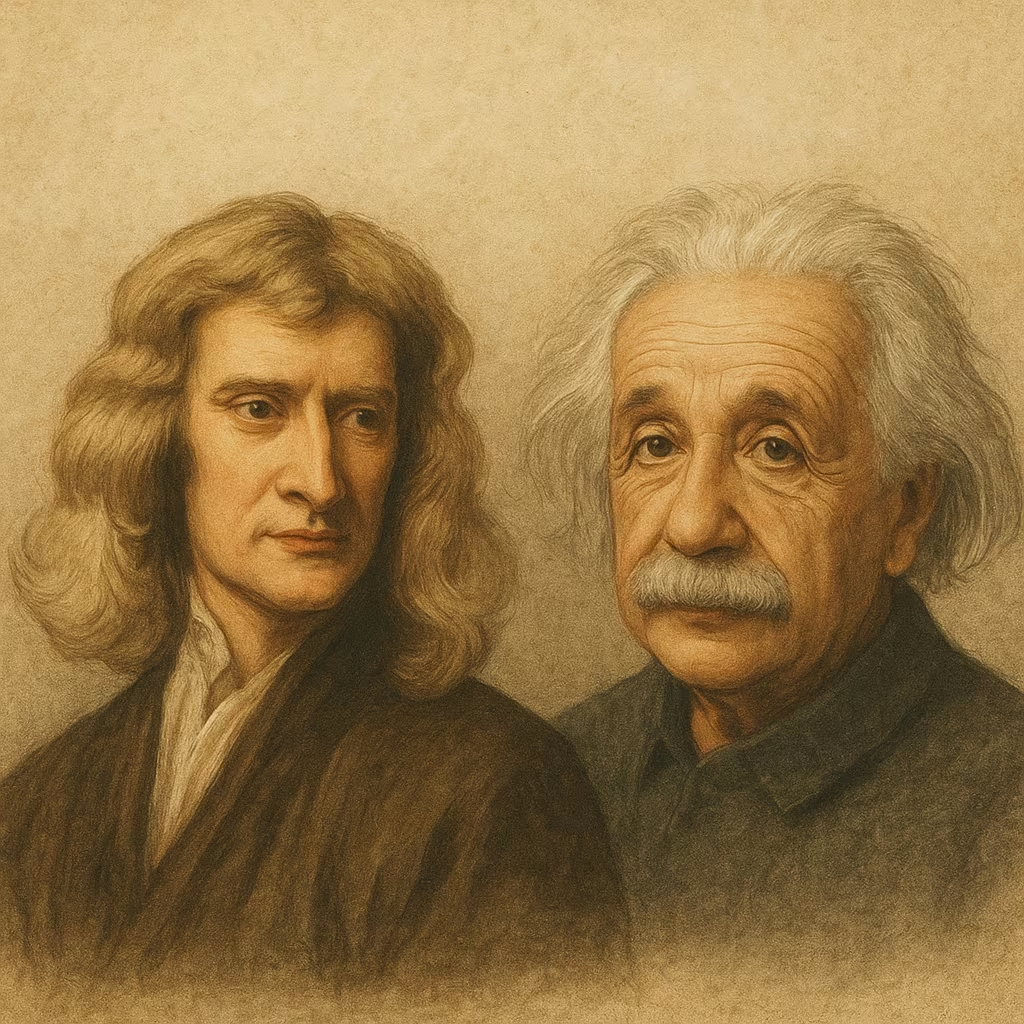
Scientists Who Changed the World: From Newton to Einstein
Discover the most influential scientists in history who revolutionized our understanding of the world. From Newton to Einstein, explore the discoveries that transformed science and society.
Scientists Who Changed the World: From Newton to Einstein
Human history has been profoundly transformed by revolutionary scientific discoveries. Some scientists have not only revolutionized their field but also changed our way of understanding the world and living. This article explores the most influential scientific figures in history and their lasting impact.
Introduction: Science as a Transformative Force
Science has always been an engine of change, but some scientists have had such a profound impact that they literally changed the course of history. Their discoveries not only advanced knowledge but also transformed society, technology, medicine, and our understanding of the universe.
This list presents the most influential scientists, selected for the scope of their impact, the revolution they brought to their field, and their lasting influence on modern science and society.
1. Isaac Newton (1643-1727): The Father of Modern Physics
Laws of Motion and Gravitation
Isaac Newton revolutionized physics with his three laws of motion and his theory of universal gravitation. Published in his “Principia Mathematica” (1687), these laws explained for the first time the motion of planets, objects on Earth, and unified celestial and terrestrial mechanics.
His discovery that the same force (gravity) governs the fall of an apple and the Moon’s orbit was a major conceptual revolution. This unification allowed accurate prediction of astronomical movements and transformed our understanding of the universe.
Impact on Modern Science
Newton’s laws remain fundamental in classical physics and are still taught today. They enabled the development of modern engineering, aeronautics, and all technologies based on mechanics.
Mathematical Legacy
Newton also developed calculus (independently of Leibniz), an essential mathematical tool for modern physics. His mathematical contributions revolutionized analysis and opened new fields of research.
Impact: Newton created the foundations of modern physics and transformed our understanding of the mechanical universe.
2. Albert Einstein (1879-1955): The Revolutionary of Physics
Theory of Relativity
Albert Einstein revolutionized physics with his special relativity (1905) and general relativity (1915). His famous equation E=mc² demonstrated the equivalence between mass and energy, opening the way to nuclear physics.
General relativity transformed our understanding of space, time, and gravity. It allowed explanation of phenomena that Newtonian physics could not explain, such as the precession of Mercury’s orbit.
Impact on Modern Technology
Einstein’s discoveries have major practical applications: GPS uses relativistic corrections to function precisely, and nuclear physics (atomic energy, nuclear medicine) derives directly from his work.
Conceptual Legacy
Einstein changed our way of thinking about the universe. His concepts of curved space-time, time relativity, and wave-particle duality profoundly influenced philosophy and our understanding of reality.
Impact: Einstein revolutionized our understanding of the universe and opened the way to modern physics, from quantum mechanics to cosmology.
3. Charles Darwin (1809-1882): The Revolutionary of Biology
Theory of Evolution
Charles Darwin revolutionized biology with his theory of evolution by natural selection, published in “On the Origin of Species” (1859). This theory explained the diversity of life and transformed our understanding of biology.
His discovery that all species share a common ancestor and evolve by natural selection was a conceptual revolution that changed our vision of humanity’s place in nature.
Impact on Science and Society
The theory of evolution became the foundation of all modern biology, from genetics to ecology. It also profoundly influenced philosophy, psychology, and our understanding of ourselves.
Modern Applications
Understanding evolution is essential in medicine (antibiotic resistance), agriculture (variety selection), and conservation (biodiversity preservation).
Impact: Darwin transformed our understanding of life and our place in nature, creating the foundations of modern biology.
4. Marie Curie (1867-1934): The Pioneer of Radioactivity
Discovery of Radioactivity
Marie Curie discovered polonium and radium, revolutionizing physics and chemistry. She was the first to isolate pure radium and developed techniques for studying radioactivity.
Her work opened a new field of research and prepared the ground for modern nuclear physics.
Medical Impact
Marie Curie’s discoveries revolutionized medicine. Radiotherapy against cancer and nuclear medicine derive directly from her research. She also developed mobile radiological units during World War I.
Pioneer Role
First woman Nobel Prize winner and only double laureate in sciences, Marie Curie broke gender barriers and became a model for women scientists.
Impact: Marie Curie revolutionized physics, transformed medicine, and opened the way for women in science.
5. Leonardo da Vinci (1452-1519): The Universal Genius
Interdisciplinary Approach
Leonardo da Vinci was a universal genius who excelled in many fields: art, science, engineering, anatomy. His interdisciplinary approach revolutionized the Renaissance and profoundly influenced modern science.
His detailed anatomical observations, mechanical inventions, and scientific studies anticipated many later discoveries.
Methodological Legacy
Leonardo developed a method of observation and experimentation that influenced the modern scientific method. His notebooks demonstrate a rigorous and systematic approach to scientific investigation.
Impact on Art and Science
His artistic works revolutionized painting, while his scientific studies influenced anatomy, engineering, and architecture. He demonstrated that art and science can enrich each other.
Impact: Leonardo da Vinci revolutionized art and science, demonstrating the importance of interdisciplinary approach and influencing generations of scientists and artists.
6. Louis Pasteur (1822-1895): The Father of Microbiology
Germ Theory
Louis Pasteur revolutionized medicine with his germ theory, demonstrating that diseases are caused by microorganisms. This discovery transformed medicine and saved millions of lives.
His experiments refuted the theory of spontaneous generation and demonstrated the importance of hygiene and sterilization.
Pasteurization
Pasteur developed the pasteurization process, which preserves food by destroying pathogenic microorganisms. This technique revolutionized the food industry and improved public health.
Vaccines
Pasteur developed the first vaccines against rabies and other diseases, creating the foundations of modern immunology. His work still saves millions of lives each year.
Impact: Pasteur revolutionized medicine, transformed public health, and created the foundations of modern microbiology and immunology.
7. Galileo Galilei (1564-1642): The Father of Modern Science
Experimental Method
Galileo revolutionized science by developing the modern experimental method. He combined observation, experimentation, and mathematization, creating the foundations of modern science.
His astronomical observations with the telescope revolutionized our understanding of the universe and confirmed Copernicus’s heliocentric model.
Impact on Philosophy
Galileo demonstrated that nature can be understood through mathematics and experimentation, revolutionizing natural philosophy and opening the way to modern science.
Scientific Legacy
His discoveries in mechanics, astronomy, and physics directly influenced Newton and all modern science. He demonstrated the importance of observation and experimentation.
Impact: Galileo created the foundations of the modern scientific method and revolutionized our understanding of the universe.
8. James Clerk Maxwell (1831-1879): The Unifier of Electromagnetism
Maxwell’s Equations
Maxwell unified electricity and magnetism with his four equations, creating the theory of electromagnetism. This unification revolutionized physics and predicted the existence of electromagnetic waves.
His equations are considered one of the greatest achievements in physics, on par with Newton’s laws and Einstein’s relativity.
Technological Impact
Maxwell’s discoveries enabled the development of all modern electrical and electronic technologies: radio, television, telecommunications, internet. Without his equations, our modern world would not exist.
Theoretical Legacy
Maxwell demonstrated the importance of theoretical unification in science, directly influencing Einstein and modern physics.
Impact: Maxwell unified electromagnetism and enabled the development of all modern technologies based on electricity.
Conclusion: The Legacy of Great Scientists
These exceptional scientists demonstrate that science can profoundly transform the world. Their discoveries not only advanced knowledge but also transformed society, technology, medicine, and our understanding of the universe.
Their contributions illustrate different aspects of science: theory (Einstein, Newton), experimentation (Galileo, Pasteur), observation (Darwin), unification (Maxwell), and interdisciplinarity (Leonardo da Vinci).
Today, as we continue to explore the universe, develop new technologies, and fight diseases, the legacy of these great scientists remains more relevant than ever. They remind us that science can transform the world and improve the human condition.
To learn more about these exceptional figures, consult our detailed biographies of these scientists who changed the world.