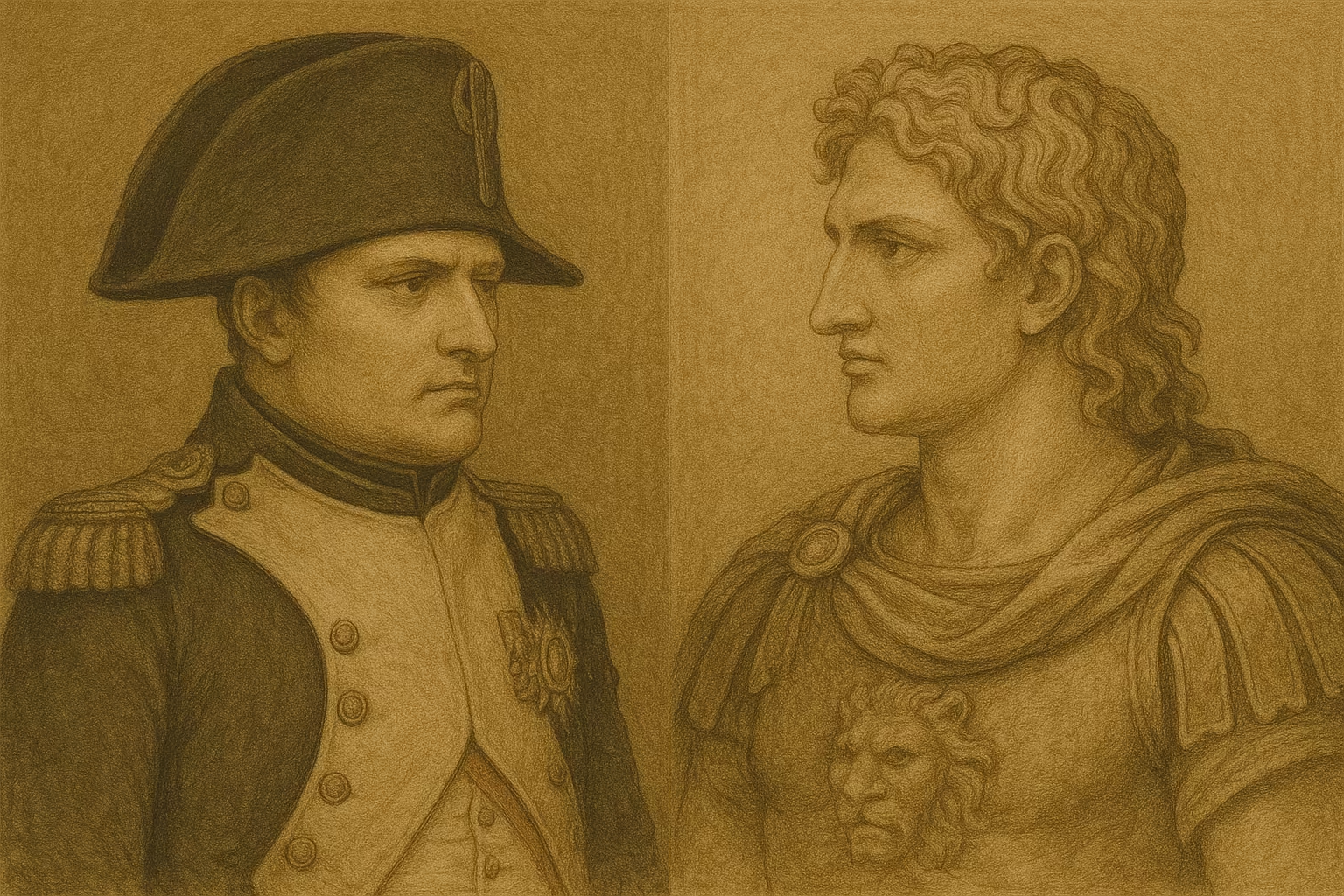
Napoleon vs Alexander the Great: Comparison of Two Legendary Conquerors
Discover the detailed comparison between Napoleon Bonaparte and Alexander the Great, two of history's greatest conquerors. Analysis of their military strategies, legacies, and impact on the world.
Napoleon vs Alexander the Great: Comparison of Two Legendary Conquerors
Napoleon Bonaparte and Alexander the Great are two emblematic figures of world military history. Separated by more than two millennia, these two conquerors nonetheless indelibly marked their era, creating empires that transformed the world. This comparative analysis explores their similarities, differences, and lasting legacy.
Introduction: Two Exceptional Destinies
Alexander the Great (356-323 BCE) and Napoleon Bonaparte (1769-1821) share an exceptional destiny: both conquered vast territories, revolutionized the art of war, and left a legacy that endures to this day. However, their historical contexts, methods, and motivations differ considerably.
This in-depth comparison examines six fundamental aspects of their careers: their origins and education, their military strategies, their management of conquered territories, their personality and leadership, their cultural and administrative legacy, and finally the reasons for their fall.
Origins and Education: Two Different Paths
Alexander the Great: Heir to an Empire
Alexander was born in 356 BCE in Pella, capital of the Kingdom of Macedonia. Son of Philip II, he benefited from exceptional education under the tutelage of Aristotle, who taught him philosophy, sciences, and literature. This exceptional intellectual training, combined with the military heritage of his father, forged a leader both cultured and formidable.
From an early age, Alexander demonstrated exceptional qualities: at 16, he already commanded the Macedonian cavalry at the Battle of Chaeronea. His education allowed him to understand and appreciate the cultures he conquered, facilitating the integration of defeated peoples.
Napoleon Bonaparte: The Rise from Nothing
Napoleon was born in 1769 in Ajaccio, Corsica, into a family of minor nobility. Unlike Alexander, he did not benefit from a princely education but owed his success to personal merit. Trained at the military school of Brienne and then at the military school of Paris, he excelled in mathematics and military strategy.
His training was essentially military and technical, without the cultural breadth of Alexander. However, Napoleon compensated with intensive reading of historical and military works, developing an in-depth knowledge of past campaigns, including those of Alexander himself.
Comparison point: Alexander benefited from complete and privileged education, while Napoleon had to forge his culture by himself, which partly explains their different approaches to conquest and governance.
Military Strategies: Tactical Genius vs Strategic Innovation
Alexander’s Tactics: The Phalanx and Cavalry
Alexander perfected the military tactics developed by his father, combining the Macedonian phalanx (heavy infantry) with elite cavalry. His strategy relied on mobility, speed of execution, and exploitation of enemy weaknesses.
At the Battle of Gaugamela (331 BCE) against Darius III, Alexander used a masterful feint: he drew Persian forces to his right, creating a breach in the center that he exploited with his companion cavalry. This tactic demonstrated his ability to adapt his plans according to the situation.
Napoleon’s Innovation: Artillery and Maneuver
Napoleon revolutionized modern warfare by integrating artillery as a central element of his strategy. Unlike previous generals who used cannons statically, Napoleon moved them rapidly on the battlefield, creating devastating concentrations of fire.
His strategy relied on the “maneuver on the rear”: dividing his army into several corps, making them converge rapidly on the decisive point, and crushing the enemy by local numerical superiority. This approach was perfected during campaigns like Italy (1796-1797) and Austerlitz (1805).
Strategic comparison: Alexander excelled in battle tactics and immediate exploitation of opportunities, while Napoleon mastered operational strategy and coordination of large armies over vast territories.
Management of Conquered Territories: Assimilation vs Administration
Alexander’s Approach: Cultural Fusion
Alexander adopted a policy of cultural assimilation remarkable for his time. Instead of brutally imposing Greek culture, he encouraged mixing and integration. He married Roxana, a Bactrian princess, and encouraged his generals to do the same with local elites.
He founded numerous cities (the Alexandrias) that served as centers for the diffusion of Greek culture while integrating local traditions. This policy created Hellenism, a cultural synthesis that lasted for centuries after his death.
Napoleon’s Approach: Administrative Modernization
Napoleon applied a policy of systematic modernization of conquered territories. He introduced the Civil Code, reorganized administration, created prefectures, and modernized infrastructure. This approach was less cultural than administrative, aiming to create modern and efficient states.
In conquered territories, Napoleon imposed his administrative and legal reforms, creating uniformity that facilitated governance but also aroused local resistance, particularly in Spain where guerrillas fiercely opposed French occupation.
Fundamental difference: Alexander sought to merge cultures, creating a new hybrid identity, while Napoleon imposed a uniform administrative model, creating resistance but also lasting structures.
Personality and Leadership: Charisma vs Meritocracy
Alexander’s Charisma
Alexander possessed exceptional charisma that inspired absolute loyalty in his troops. He shared dangers with his soldiers, fighting in the front line and enduring the same privations. This proximity created a unique bond between commander and his men.
His leadership relied on personal example and generosity toward his companions. He generously distributed conquered wealth and honored his soldiers, creating a devoted army that followed him to the ends of India.
Napoleon’s Organizational Genius
Napoleon was an organizational genius, capable of simultaneously managing multiple fronts and coordinating complex operations. His leadership relied on competence, merit reward, and effective communication with his subordinates.
Unlike Alexander, Napoleon commanded from his headquarters, using messengers and codes to coordinate his armies. He created a reward system (Legion of Honor) that motivated his soldiers through merit recognition rather than personal charisma.
Contrast: Alexander led by example and charisma, Napoleon by organization and meritocracy. Both approaches were effective but reflect different personalities and eras.
Cultural and Administrative Legacy
Alexander’s Legacy: Hellenism
Alexander’s legacy far exceeds his military conquests. He created Hellenism, a hybrid culture that fused Greek traditions with those of the East. This cultural legacy lasted for centuries, influencing art, philosophy, and science throughout the Mediterranean basin and beyond.
The cities he founded became centers of knowledge and commerce, notably Alexandria in Egypt which housed the greatest library of antiquity. Hellenism also prepared the advent of Christianity by creating a common language (Koine Greek) and cultural networks.
Napoleon’s Legacy: The Modern State
Napoleon’s legacy is above all institutional and administrative. The Civil Code he created still influences the legal systems of many countries today. His administrative reforms (prefects, lycées, metric system) created the structures of the modern state.
Unlike Alexander, Napoleon’s legacy is less cultural than institutional. He created lasting structures that shaped modern Europe, but his cultural influence was less profound and less durable than Alexander’s.
Comparison: Alexander left a profound and lasting cultural legacy, while Napoleon created administrative and legal structures that shaped the modern state.
Reasons for Their Fall
Alexander’s Premature Death
Alexander died at 32, probably from illness (fever or poisoning), before he could consolidate his empire. His premature death caused the fragmentation of his empire among his generals (the Diadochi), ending the unity he had created.
His fall was therefore due to external circumstances (illness) rather than strategic errors or military defeats. Until his death, he remained undefeated on the battlefield.
Napoleon’s Fall: Strategic Errors
Napoleon committed several major strategic errors that led to his fall: the invasion of Spain which bogged down in guerrilla warfare, the invasion of Russia in 1812 which decimated the Grande Armée, and finally the defeat at Waterloo in 1815.
Unlike Alexander, Napoleon was militarily defeated several times, notably at Leipzig (1813) and Waterloo (1815). His fall was the result of judgment errors and exhaustion of his resources against determined European coalitions.
Difference: Alexander remained undefeated but died prematurely, while Napoleon committed strategic errors that led to his military defeat.
Conclusion: Two Models of Conquest
Napoleon and Alexander the Great represent two complementary models of conquest and leadership. Alexander excelled in tactics, charisma, and cultural fusion, creating a lasting cultural legacy. Napoleon mastered operational strategy, organization, and administration, creating lasting institutional structures.
Their differences also reflect their eras: Alexander operated in a world where communications were limited and personal charisma was essential, while Napoleon benefited from modern administrative structures and improved means of communication.
Today, their legacy endures: Alexander’s in culture and arts, Napoleon’s in institutions and law. Both demonstrate that an exceptional leader can durably transform the world, whether through culture or institutions.
This article is part of our comparative series on history’s great conquerors. To learn more, consult our detailed biographies of Napoleon Bonaparte and Alexander the Great.