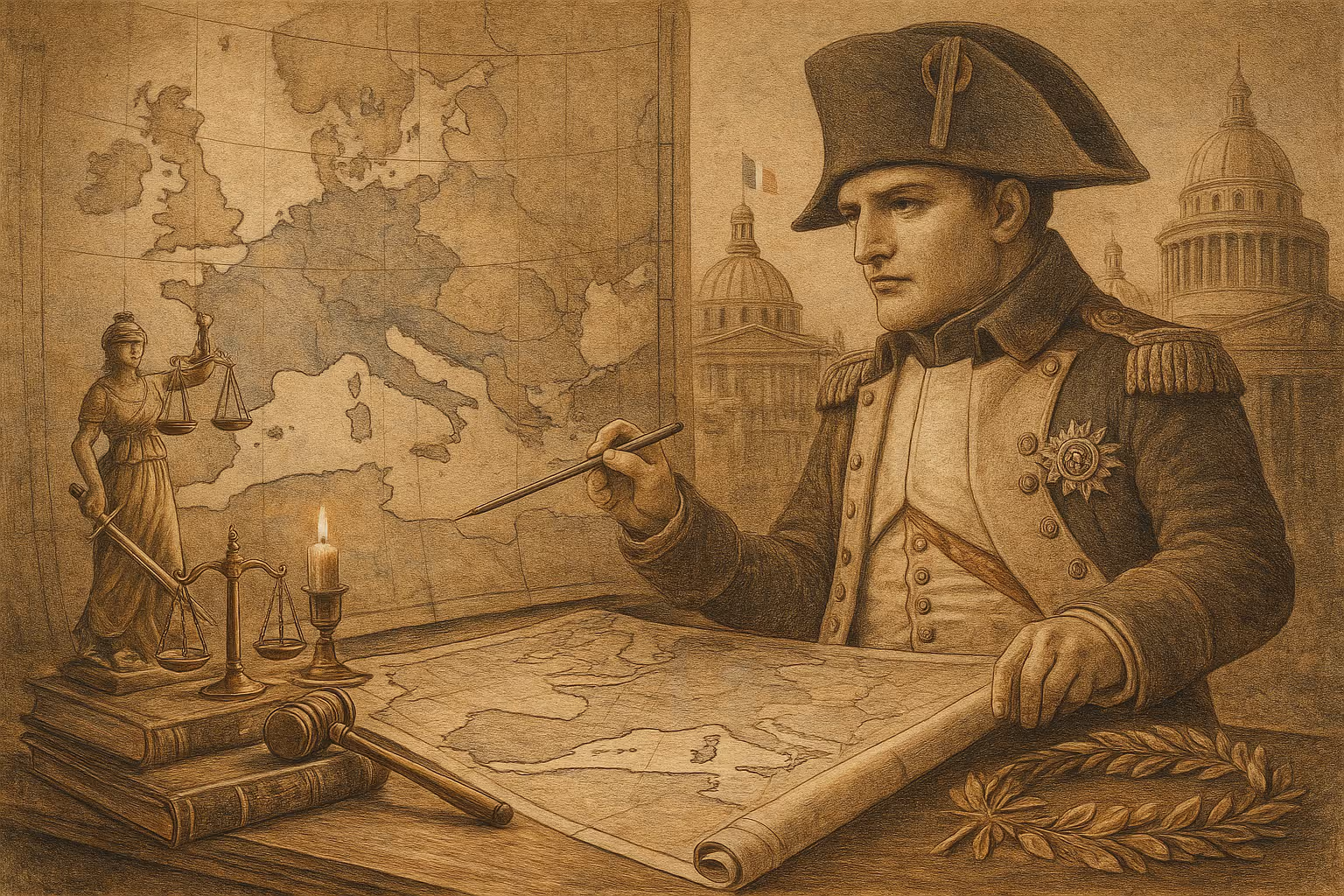
The Napoleonic Legacy in Europe: How Napoleon Permanently Transformed the Continent
Discover how Napoleon Bonaparte permanently transformed political, legal, administrative, and cultural Europe. In-depth analysis of his legacy that still endures today in modern institutions.
The Napoleonic Legacy in Europe: How Napoleon Permanently Transformed the Continent
Napoleon Bonaparte’s influence on modern Europe extends far beyond his spectacular military conquests. Although his empire collapsed in 1815, his legal, administrative, cultural, and institutional legacy continues to profoundly shape our contemporary societies, two centuries after his death. From France to Poland, from Italy to Spain, Napoleonic reforms laid the foundations of the modern European state.
This article explores in detail how a single man, in the space of fifteen years, managed to permanently transform the political, legal, and social structures of an entire continent, creating a state model that still influences our modern democracies.
The Civil Code: An Unprecedented Legal Revolution
The Civil Code of 1804, also known as the Napoleonic Code, represents without question one of the most enduring and influential reforms of the Napoleonic era. This major legal work, developed under Napoleon’s personal direction, revolutionized French law and served as a model for many European countries and beyond.
The Genesis of the Civil Code
Before the French Revolution, French law was a veritable patchwork of local customs, royal laws, and regional traditions. Each province had its own rules, creating legal complexity that hindered commerce and national unity. Napoleon, convinced of the need to unify the law, personally involved himself in the development of the Civil Code, presiding over more than half of the Council of State sessions devoted to this project.
The Civil Code of 1804, composed of 2,281 articles, was designed to be clear, accessible, and applicable to all citizens, regardless of their social origin. This accessibility was revolutionary at a time when law was often the preserve of jurists and nobles.
Fundamental Principles of the Napoleonic Code
The Civil Code is based on several fundamental principles that marked a break with the Ancien Régime:
Equality before the law: The Code definitively abolished birth privileges. All citizens are equal before the law, without distinction of social class. This principle, inherited from the Revolution, was codified and strengthened by Napoleon.
Private property: The Code enshrines private property as an inviolable and sacred right. It establishes clear rules on the acquisition, transmission, and protection of property, thus promoting the legal security necessary for economic development.
Secularism of civil law: The Code definitively separates civil law from canon law. Marriage becomes a civil contract, divorce is authorized (although restricted), and civil status is entrusted to the State rather than the Church.
Freedom of contract: Individuals are free to contract, subject to respecting public order and good morals. This principle favored the development of commerce and industry.
Paternal authority: The Code strengthens the authority of the head of the family, a reflection of the values of the time, but also establishes clear rules on guardianship and protection of minors.
The International Influence of the Civil Code
The impact of the Civil Code extends far beyond French borders. It has been adopted or strongly influenced the legal systems of many countries:
- Belgium: The Civil Code is still in force there, with minor modifications
- Luxembourg: Still uses the Napoleonic Civil Code as the basis of its law
- Italy: The Italian Civil Code of 1865 was largely inspired by the Napoleonic model
- Spain: The Spanish Civil Code of 1889 incorporates many principles of the Napoleonic Code
- Netherlands: The Dutch Civil Code of 1838 is directly inspired by the French Code
- Poland: The Polish Civil Code of 1807 was an adaptation of the Napoleonic Code
- German states: The Civil Code influenced the development of German law, particularly in the Rhineland regions
- Quebec: The Quebec Civil Code is still inspired by the Napoleonic model
- Louisiana: The American state of Louisiana uses a legal system based on the French Civil Code
Even countries as distant as Japan, Turkey, and several Latin American nations have adapted the Napoleonic Civil Code to their needs, demonstrating the universality of its principles.
Administrative Reorganization: The Foundations of the Modern State
Napoleon revolutionized French administration by creating structures that still exist today. His administrative system, based on centralization and hierarchy, served as a model for many European states.
The Prefectural System
One of Napoleon’s major innovations is the creation of the prefectural system in 1800. Prefects, directly appointed by the central power, represent the State in each department. This system allows uniform and efficient administration throughout the territory, while maintaining centralized control.
The prefect is responsible for:
- Applying government laws and decrees
- Supervising local administration
- Maintaining public order
- Coordinating state services in their department
This prefectural system still exists in France and has been adopted by many European countries, notably Italy and Spain.
Educational Reform: Lycées and the Imperial University
Napoleon created the lycée system in 1802, establishing a network of public and secular secondary education. These institutions, intended to train the nation’s elites, offer free education to the best students, selected on the basis of merit rather than birth.
In 1808, Napoleon founded the Imperial University, a centralized institution that controls the entire French education system, from primary school to university. This centralized structure, although modified since, laid the foundations of the modern French education system.
The Legion of Honor: A Meritocratic System
Created in 1802, the Legion of Honor revolutionized the French reward system. Unlike the orders of the Ancien Régime reserved for the nobility, the Legion of Honor rewards merit, whether military, civil, scientific, or artistic. This meritocratic system symbolizes Napoleonic values and still exists today.
The Bank of France and Monetary Reform
Napoleon also modernized the French financial system by creating the Bank of France in 1800 and establishing the franc germinal as a stable currency. This monetary reform favored economic development and served as a model for other European countries.
Impact on Europe: Diffusion of Napoleonic Reforms
Napoleonic expansion spread these reforms across Europe, creating a model of the modern state that inspired 19th-century European nations. Each conquered or allied territory was reorganized according to Napoleonic principles.
Germany: Modernization and Unification
In the German states, Napoleonic reforms accelerated administrative and legal modernization. The Civil Code was introduced in many regions, particularly in the Confederation of the Rhine. These reforms prepared the ground for German unification in 1871, by demonstrating the advantages of centralized administration and unified law.
Italy: Toward National Unity
In Italy, Napoleonic occupation administratively unified territories that were previously divided into many states. Napoleonic reforms created a sense of Italian unity and demonstrated the feasibility of a unified Italy, thus preparing the Risorgimento.
Spain: Forced Modernization
In Spain, despite resistance to French occupation, Napoleonic reforms introduced modern concepts of administration and law. The Spanish Civil Code of 1889 was largely inspired by the Napoleonic model.
Poland: Administrative Renaissance
The Duchy of Warsaw, created by Napoleon in 1807, benefited from modern administration and the Civil Code. Although this duchy was short-lived, it left lasting traces in Polish administrative structures.
The Netherlands and Belgium
Napoleonic reforms deeply marked the Netherlands and Belgium. The Civil Code is still in force there, and the modern administrative structures of these countries owe much to the Napoleonic model.
Cultural and Intellectual Legacy
Beyond institutional reforms, Napoleon also left an important cultural and intellectual legacy.
The Louvre Museum and Heritage Protection
Napoleon transformed the Louvre into a universal museum, gathering works of art from all over Europe. This policy of protecting and enhancing cultural heritage influenced the creation of many national museums in Europe.
The Metric System
Although the metric system was created during the Revolution, it was under Napoleon that it was generalized and imposed in conquered territories. This unified system of measurement facilitated commerce and exchanges, and is now used in most countries of the world.
Encouragement of Sciences and Arts
Napoleon encouraged sciences, arts, and letters, creating institutions like the Institut de France. This policy of state patronage influenced European cultural development.
Military and Strategic Legacy
Napoleon’s military legacy is also considerable. His tactical and strategic innovations influenced modern warfare for more than a century.
Napoleonic Principles of War
Napoleon developed principles of war that are still taught in military academies:
- Concentration of forces
- Maneuver and surprise
- Combined use of arms
- Logistics and supply
Influence on Modern Military Strategy
Napoleonic campaigns served as a model for 19th and 20th century strategists. Generals like Moltke, Jomini, and even more recent theorists studied and adapted Napoleonic methods.
Economic Legacy
Napoleonic economic reforms also left lasting traces:
The Continental System
Although the Continental System was a strategic failure, it stimulated European industry by encouraging economic autonomy and technological innovation.
Infrastructure
Napoleon had many roads, bridges, and canals built, improving communications and favoring commerce. Some of this infrastructure still exists today.
Posterity and Contemporary Influence
The Napoleonic legacy continues to influence our contemporary world in multiple ways.
Modern Institutions
Many modern European institutions still bear the Napoleonic mark:
- Centralized administrative systems
- Civil codes based on the Napoleonic model
- Centralized education systems
- Modern military structures
The Nation-State Model
Napoleon contributed to defining the modern nation-state model, with its characteristics:
- A delimited territory
- A unified population
- A centralized government
- A uniform legal system
- Efficient administration
This model influenced the formation of European nation-states in the 19th century and continues to inspire modern state structures.
Conclusion: A Multifaceted and Enduring Legacy
The Napoleonic legacy transcends borders and eras. His reforms laid the foundations of the modern European state, demonstrating that a visionary leader can permanently transform the structures of an entire continent.
From France to Poland, from Italy to Spain, traces of Napoleonic work are everywhere visible: in civil codes, administrative systems, educational structures, and even in how we conceive the modern state.
This legacy, although controversial due to the authoritarian aspects of the Napoleonic regime, nevertheless represents a major contribution to the modernization of Europe. The principles of equality before the law, meritocracy, and efficient administration that Napoleon codified continue to guide our modern democracies.
Understanding the Napoleonic legacy means understanding the foundations of modern Europe. It also means recognizing that a leader’s influence can endure well beyond their reign, shaping future societies in a profound and lasting way.
This article is part of our series on the great reformers of European history. To learn more about Napoleon Bonaparte, consult his complete biography on our site.