Died Too Young: What History Actually Lost
Alexander at 32, Joan of Arc at 19, Mozart at 35, Pierre Curie under a cart. Eight deaths, and what was genuinely underway when each one happened.
Counterfactual history is slippery ground. “What if Alexander had lived another twenty years?” has no answer, and pretending otherwise is fiction.
What can be documented is what was actually in motion at the moment of death: the projects underway, the unfinished manuscripts, the unsettled successions. There the facts speak, and they are enough to measure the gap.
Eight cases, oldest first.
Alexander the Great — 32 (323 BC)
He died in Babylon in June 323, after eleven days of fever. He had just received embassies from across the Mediterranean and was preparing an expedition into Arabia.
What was underway: an empire running from Greece to the Indus, unified for less than a decade, held together by his person alone. No designated heir, no institution of succession.
Alexander died, and his generals carved it up over forty years of war. The empire never existed without him for more than a few months.
Joan of Arc — 19 (1431)
Burned at Rouen on 30 May 1431, after a trial whose minutes survive.
What was underway: Charles VII had been crowned at Reims two years earlier because of her. French military momentum was established, and it continued without her until the end of the Hundred Years’ War twenty-two years later.
That is the particularity of Joan of Arc: her military work outlived her. A rehabilitation trial annulled the verdict in 1456. She was canonized in 1920, nearly five centuries on.
Mozart — 35 (1791)
Died in Vienna on 5 December 1791, of an acute illness whose diagnosis is still argued over.
What was underway: the Requiem, an anonymous commission, left unfinished. His pupil Franz Xaver Süssmayr completed it — and who wrote what is debated to this day.
1791 was not the end of a career. Mozart had just premiered The Magic Flute and La clemenza di Tito. He was writing at pace, with no sign of decline.
Ada Lovelace — 36 (1852)
Died of cancer on 27 November 1852.
What was underway: nothing comparable to her 1843 notes on the Analytical Engine. She never returned to the subject, for lack of an object — Babbage never built the machine.
The loss here is not an interrupted work but an insight with no successor. Ada Lovelace had grasped that a calculating engine could manipulate arbitrary symbols. A century would pass before anyone rediscovered it.
Pierre Curie — 46 (1906)
On 19 April 1906, on the rue Dauphine in Paris, he slipped crossing in the rain and went under the wheels of a horse-drawn wagon.
What was underway: three years after the Nobel in physics shared with Marie Curie and Becquerel, the couple were exploring the properties of radium and its medical applications.
What followed is well known: Marie took over Pierre’s chair at the Sorbonne — the first woman to teach there — and won a second Nobel, in chemistry, in 1911.
This is the most brutal case on the list. Not illness, not execution: a wet street.
Sophie Scholl — 21 (1943)
Arrested on 18 February 1943 for distributing White Rose leaflets at the University of Munich. Tried and guillotined four days later.
What was underway: a student resistance network whose texts were beginning to circulate beyond Munich. The sixth leaflet, smuggled out of Germany, would be air-dropped over the country by the Allies.
Here the brevity is the central fact. Between Sophie Scholl’s arrest and her execution, less than a week passed.
Abraham Lincoln — 56 (1865)
Shot on 14 April 1865, died the next morning. Five days after Lee’s surrender at Appomattox.
What was underway: Reconstruction. Lincoln had just won the war and was turning to the far harder question of reintegrating the South and settling the status of the freedmen.
Policy passed to Andrew Johnson, whose clashes with Congress led to impeachment proceedings. Lincoln is the only figure here whose death fell exactly on the hinge between the solved problem and the next one.
Rosalind Franklin — 37 (1958)
Died of ovarian cancer on 16 April 1958.
What was underway: after DNA, she had built a team working on virus structure, notably tobacco mosaic virus — work that remains authoritative.
Four years later the Nobel went to Watson, Crick and Wilkins. It is not awarded posthumously; what the committee would have decided is unknowable. We cover that in Marie Curie vs Rosalind Franklin.
What these eight cases actually teach
Three observations hold where speculation does not.
What depends on one person does not outlive them. Alexander’s empire collapsed because it was nothing but him. France carried on without Joan of Arc in 1431 because the coronation had transferred legitimacy to an institution. The difference is not of degree but of kind.
Unfinished work closes badly. The Requiem exists, but in a version nobody can fully attribute. That is the most measurable form of the loss.
Chance weighs as heavily as violence. Across these eight deaths: two executions, one assassination, three illnesses, one traffic accident, one unidentified fever. No pattern, no meaning. That may be the only solid lesson the exercise yields.
For another way to recalibrate your sense of historical time, see historical figures who were alive at the same time.
Read Next
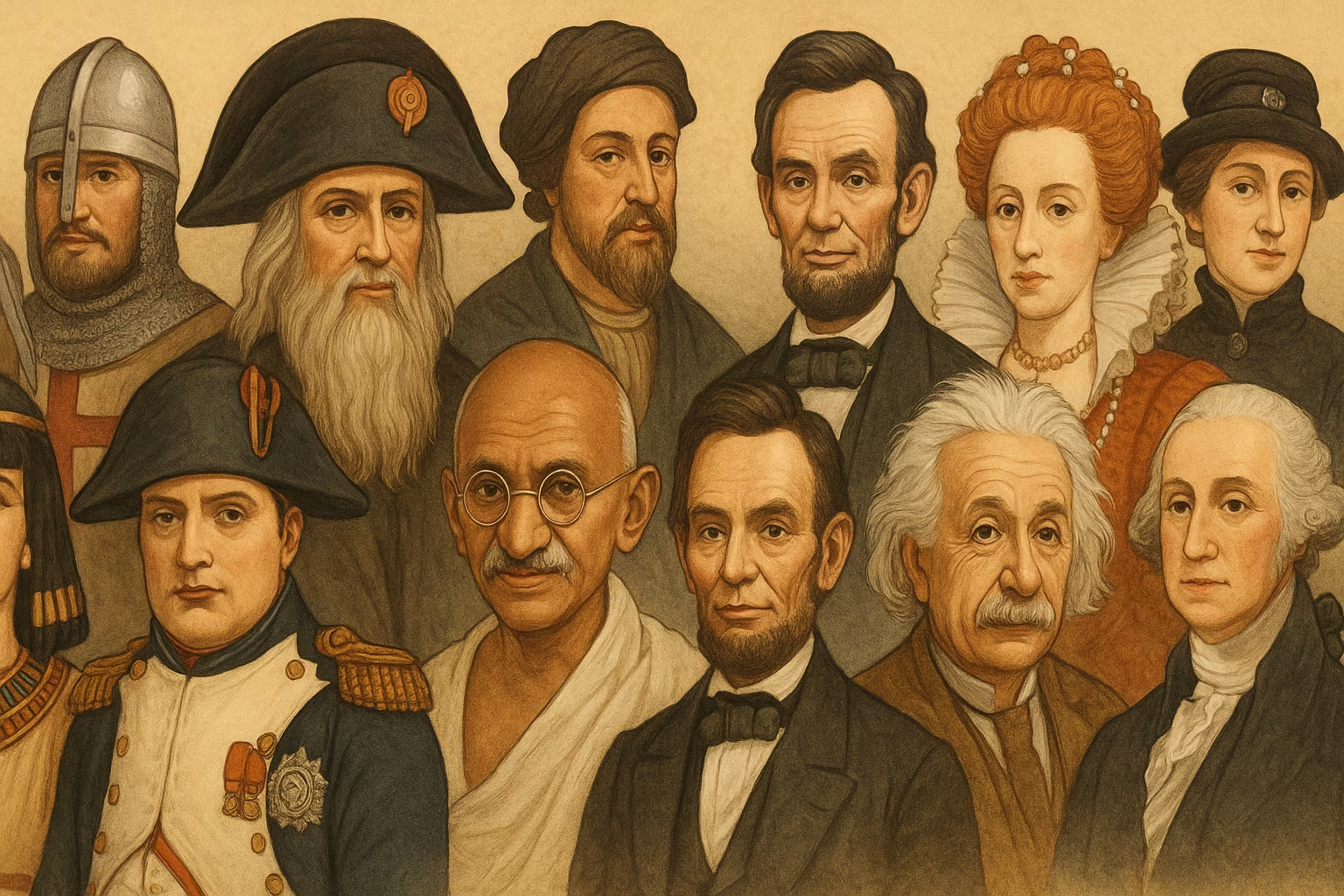
Historical Figures Who Were Alive at the Same Time
Cleopatra was born closer to the Moon landing than to the Great Pyramid. Darwin and Lincoln share a birthday. Ten overlaps that break your sense of historical time.
11min read
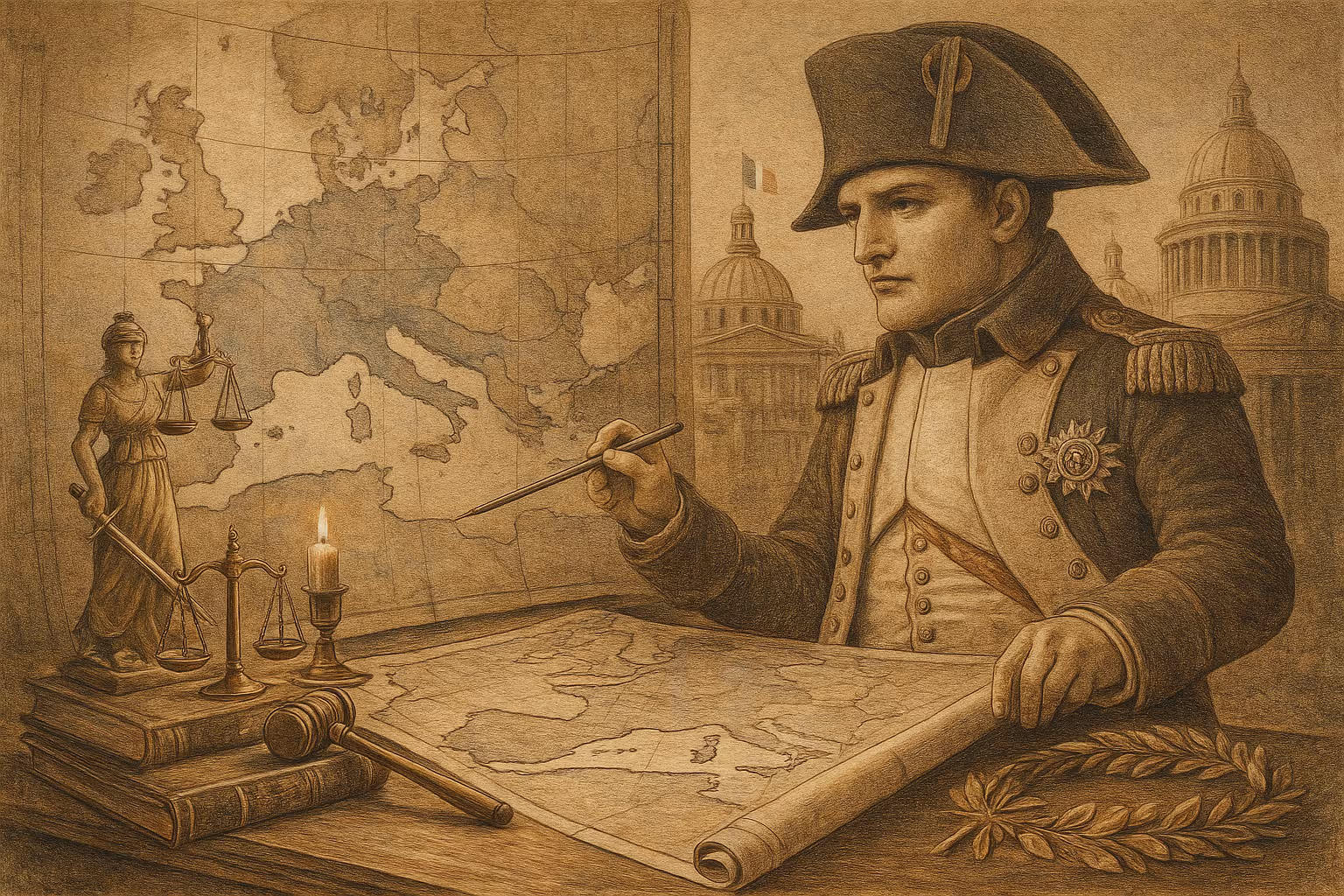
Napoleon Legacy: How He Reshaped Modern Europe
The Napoleonic Code, the metric system, modern bureaucracy, redrawn borders. What Napoleon left behind still runs much of Europe two centuries later.
18min read
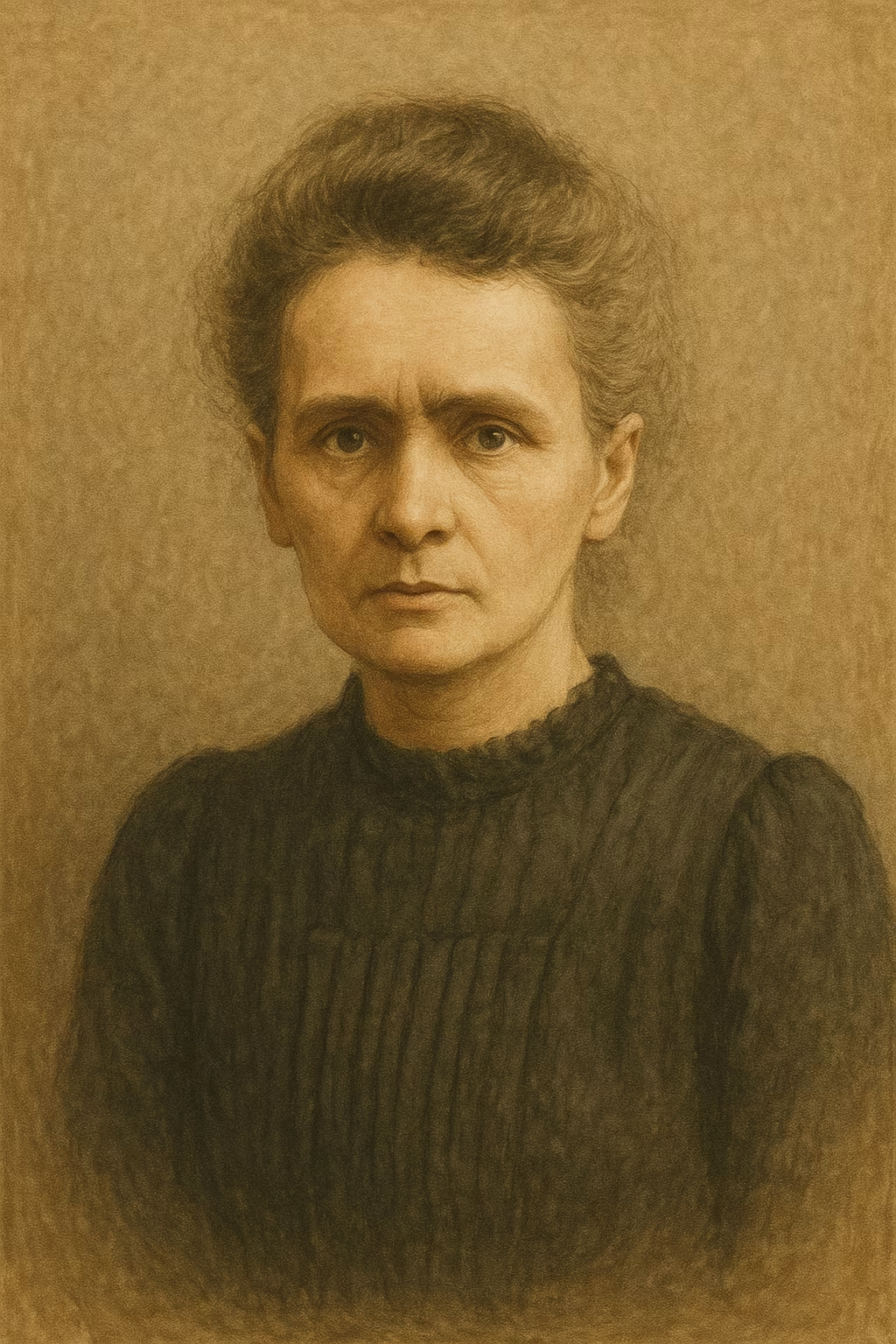
Why Is Marie Curie Important? Discoveries and Legacy
Two Nobel Prizes in two sciences, the discovery of radium and polonium, and the foundation of radiation therapy. What she did and why it still matters.
10min read
10 History Myths Everyone Still Believes
Napoleon wasn't short, Einstein never failed math, and Marie Antoinette never said it. Ten myths, and where each one actually came from.
12min read