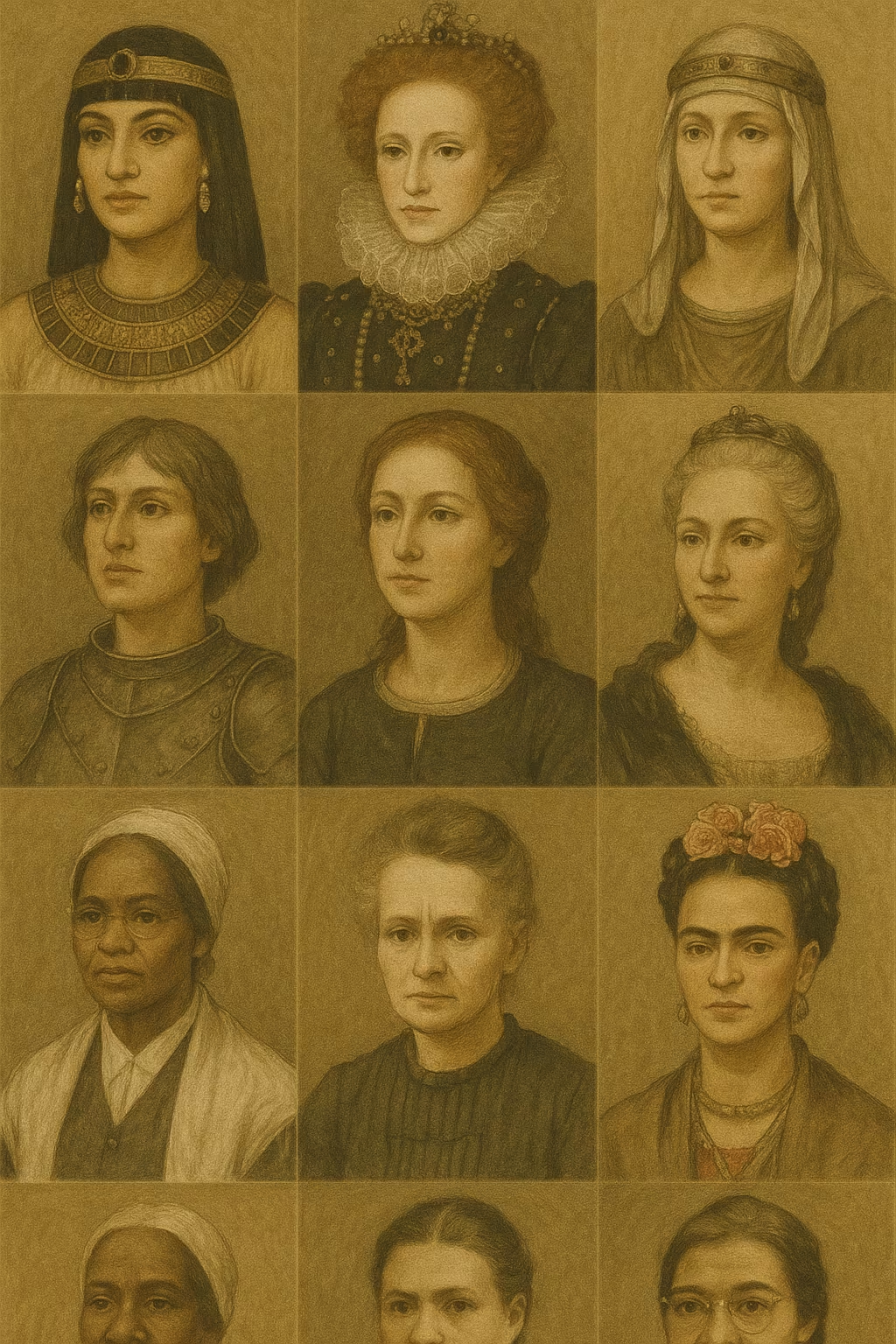
The 10 Most Powerful Women in History: From Cleopatra to Marie Curie
Discover the 10 most influential and powerful women in world history. From Cleopatra to Marie Curie, explore the exceptional journeys of these figures who marked their era despite obstacles.
The 10 Most Powerful Women in History: From Cleopatra to Marie Curie
History abounds with exceptional women who defied the conventions of their time to exercise power, influence their society, and leave a lasting mark. This article explores the journeys of ten remarkable women who marked world history, from antiquity to the contemporary era.
Introduction: Female Power Through the Ages
For centuries, societies have often limited the role of women, excluding them from positions of power and influence. Yet, some women have managed to overcome these obstacles, becoming leaders, innovators, revolutionaries, or major intellectual figures. Their legacy demonstrates that talent and determination can transcend social and cultural barriers.
This list presents ten exceptional women, selected for their historical impact, lasting influence, and ability to transform their era. They represent different domains: politics, science, literature, religion, and social revolution.
1. Cleopatra VII (69-30 BCE): The Queen of Queens
Exceptional Power in Antiquity
Cleopatra VII, last queen of Ptolemaic Egypt, was one of the most powerful women of antiquity. Polyglot (she spoke nine languages), she ruled Egypt for more than twenty years, skillfully navigating Roman political intrigues.
Strategy and Influence
Her alliance with Julius Caesar then with Mark Antony demonstrated her ability to use diplomacy and charm to preserve Egypt’s independence against Roman power. She was the only ruler of her time to successfully challenge Rome for years.
Cultural Legacy
Cleopatra became a symbol of female power and beauty, inspiring generations of artists and writers. Her suicide after the defeat at Actium marked the end of independent Egypt but cemented her legend.
Why she is powerful: She ruled a rich and strategic kingdom, influenced Roman politics, and became a lasting cultural legend.
2. Joan of Arc (1412-1431): The Divine Warrior
A Prophetic Mission
Joan of Arc, a French peasant, claimed to receive divine visions ordering her to liberate France from English occupation during the Hundred Years’ War. At only 17, she convinced the dauphin Charles VII to entrust her with an army.
Military Victories
She led French troops to several decisive victories, notably the siege of Orléans (1429), which marked a turning point in the war. Her courage and determination galvanized French troops and restored hope to a demoralized nation.
Martyrdom and Canonization
Captured by the Burgundians, she was tried for heresy and burned alive at Rouen in 1431. Canonized in 1920, she became the patron saint of France and a symbol of courage and determination.
Why she is powerful: She changed the course of a major war, inspired an entire nation, and became a lasting religious and national symbol.
3. Catherine the Great (1729-1796): The Empress of the Enlightenment
Rise to Power
Sophie of Anhalt-Zerbst, a German princess, became Catherine II of Russia after overthrowing her husband Peter III in 1762. She reigned for 34 years, transforming Russia into a major European power.
Reforms and Expansion
Catherine modernized Russia, introducing reforms inspired by the Enlightenment, developing education and the arts, and considerably expanding Russian territory. She corresponded with Voltaire and Diderot, positioning herself as an enlightened sovereign.
Contradictions and Legacy
Despite her Enlightenment ideals, she strengthened serfdom and repressed peasant revolts. Her reign illustrates the contradictions of absolute power and the gap between ideals and political reality.
Why she is powerful: She ruled the largest empire in Europe, modernized Russia, and considerably expanded its territory, creating a lasting power.
4. Marie Curie (1867-1934): The Science Pioneer
First Woman Nobel Prize Winner
Marie Curie was the first woman to receive a Nobel Prize (Physics, 1903) and the only person to receive two in two different disciplines (Physics and Chemistry, 1911). She discovered polonium and radium, paving the way for nuclear medicine.
Challenges and Perseverance
Born in Poland under Russian domination, she overcame many obstacles: poverty, exclusion from universities (reserved for men), and sexist prejudices. She pursued her studies in Paris and became the first woman professor at the Sorbonne.
Scientific and Social Impact
Her discoveries revolutionized science and medicine. During World War I, she developed mobile radiology units (“Petites Curies”) that saved thousands of lives. She became a symbol of female scientific excellence.
Why she is powerful: She revolutionized science, broke gender barriers in research, and became a model for women scientists worldwide.
5. Rosa Parks (1913-2005): The Mother of the Civil Rights Movement
A Simple but Powerful Act of Defiance
On December 1, 1955, Rosa Parks, an African-American seamstress, refused to give up her seat to a white passenger on a bus in Montgomery, Alabama. This seemingly simple gesture triggered the Montgomery bus boycott, led by Martin Luther King Jr.
Movement Impact
The boycott lasted 381 days and resulted in the desegregation of public transportation. Rosa Parks became a symbol of peaceful resistance and the American civil rights movement.
Legacy and Recognition
She received the Presidential Medal of Freedom and the Congressional Gold Medal. Her act of courage inspired generations of civil rights activists and demonstrated the power of non-violent resistance.
Why she is powerful: A simple act of defiance triggered a national movement that transformed American civil rights and inspired the entire world.
6. Simone de Beauvoir (1908-1986): The Pioneer of Modern Feminism
Intellectual and Philosopher
Simone de Beauvoir was a French philosopher, writer, and feminist who revolutionized thought on gender and women’s rights. Her book “The Second Sex” (1949) became a foundational text of modern feminism.
Theory and Action
She developed the theory that “one is not born, but rather becomes, a woman,” analyzing how society constructs gender roles. She actively campaigned for the right to abortion and gender equality.
Lasting Influence
Her work profoundly influenced the global feminist movement and continues to inspire contemporary debates on gender and equality. She demonstrated that intellectual thought can transform society.
Why she is powerful: She revolutionized feminist thought, influenced generations of women, and contributed to transforming women’s rights worldwide.
7. Queen Nzinga (1583-1663): The Anti-Colonial Warrior
Resistance Against the Portuguese
Nzinga Mbande, queen of Ndongo and Matamba (present-day Angola), fiercely resisted Portuguese colonization for more than 40 years. She used diplomacy, war, and alliance with the Dutch to preserve her kingdom’s independence.
Military Strategy and Diplomacy
She formed a mixed army (men and women), negotiated directly with the Portuguese, and used her intelligence to maintain her power. She was one of the few African rulers to successfully resist European colonization.
Pan-African Legacy
She became a symbol of African resistance and female leadership, inspiring African liberation movements of the 20th century. Her name remains synonymous with courage and determination.
Why she is powerful: She resisted a European colonial power for decades, preserved her kingdom’s independence, and became a symbol of African resistance.
8. Hypatia of Alexandria (c. 370-415): The Mathematician and Philosopher
Scholar of Late Antiquity
Hypatia was a Greek mathematician, astronomer, and philosopher who taught in Alexandria. She headed the Neoplatonic school and was recognized as the greatest intellectual of her time.
Intellectual Influence
She taught students from throughout the Roman Empire, developing mathematics and astronomy. Her work influenced generations of scholars and she became a symbol of female erudition.
Martyrdom and Legend
She was assassinated by a fanatical Christian mob in 415, becoming a symbol of the persecution of knowledge by religious intolerance. Her death marked the end of Alexandria’s intellectual golden age.
Why she is powerful: She was the greatest intellectual of her era, influenced science and philosophy, and became a symbol of female erudition and resistance to intolerance.
9. Yaa Asantewaa (1840-1921): The Ashanti Warrior Queen
Resistance Against the British
Yaa Asantewaa, queen mother of the Ashanti (present-day Ghana), led the last major war against British colonization in 1900. At 60, she took the lead of the resistance after men had hesitated to fight.
Leadership and Courage
She galvanized Ashanti troops, organizing the defense of Kumasi against British forces. Although finally defeated and exiled, her resistance became legendary and inspired African independence movements.
Symbol of Resistance
She became a symbol of female courage and anti-colonial resistance, demonstrating that women can lead wars and inspire entire nations.
Why she is powerful: She led a major war against a colonial power, inspired national resistance, and became a symbol of courage and determination.
10. Sor Juana Inés de la Cruz (1648-1695): The Poet and Intellectual
Scholar of the Golden Age
Sor Juana was a Mexican nun, poet, playwright, and intellectual of the Spanish Golden Age. She was one of the greatest writers in the Spanish language and an early advocate for women’s right to education.
Defense of Women’s Education
She wrote texts defending women’s right to education and knowledge, defying the conventions of her time. Her library of 4000 volumes was one of the largest in America.
Literary Legacy
Her poetic and dramatic work influenced Hispanic-American literature and she became a symbol of the independent female intellectual. She demonstrated that women can excel in arts and letters.
Why she is powerful: She was one of the greatest writers of her era, defended women’s education, and profoundly influenced Hispanic-American literature.
Conclusion: Female Power Through History
These ten exceptional women demonstrate that power and influence are not reserved for one gender. Each, in her own way, overcame the obstacles of her era to exercise a lasting influence on history.
Their varied journeys - from warrior queen to scientist, from revolutionary to intellectual - show that female leadership can take many forms. Their legacy continues to inspire current and future generations, demonstrating that talent and determination can transform the world.
Today, as women increasingly access positions of power, these historical figures remind us that female leadership is not new but has been an integral part of human history for millennia.
This article is part of our series on women in history. To learn more, consult our detailed biographies of these exceptional figures.